I became a teacher because of an amazing teacher I had in high school. I had always enjoyed school and had teachers that were nice, knowledgeable, or friendly. However, it wasn’t until my junior year that I had a teacher that was passionate. You could feel it as soon as you walked in her room. She loved everything about her job. She loved her students, she loved the content she was teaching, and she loved to push her students to be their best. It was visible to all of her students. After having world history with Miss Chandler, I took every elective that she taught her senior year. I feel in love with history because of Miss Chandler, but more importantly I realized the importance of allowing students to see the passions of their teacher.
I went on to college where I chose get licensed in both social studies and mathematics. After graduating, I was lucky enough to be given a job teaching math at my old junior high. I had a chance to be the next Miss Chandler for my students. I had a chance to show my students that they could find a love of a subject that many students have an adverse feeling towards. At the beginning of my career, my focus was on helping students to realize that they were capable of succeeding in a math classroom. I focused in on building up their confidence and skill set. However, at the end of each year I realized that my students wanted more. They would acknowledge that they had more confidence in their skill set and they would say that they learned more in my class than they had in other math classrooms before, however, they were indifferent to the importance of this.
That led me to shifting my focus seven years ago. I still believe that my primary purpose to to make sure that every student who leaves my room realizes that they are a math person because there is no such thing as someone who is not a math person. I want my students to be content experts AND to see the relevance of math in their lives. I have found that once I started to show my students how truly passionate I am about math’s relevance in their lives they started to invest and believe in it more.
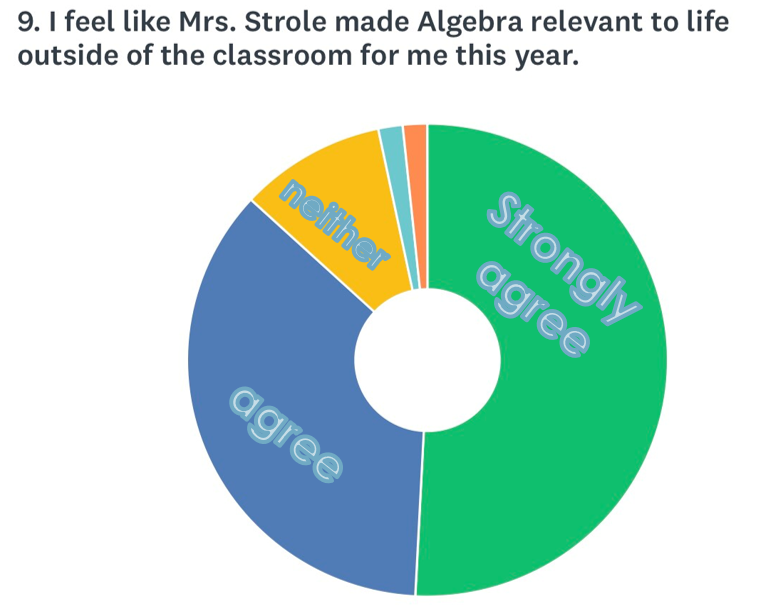
I have watched as my students response to year end surveys have gone from below 60% to as high as 94% this year. The question is simple, “After taking Mrs Strole’s class, I can now see the relevance of math in my life.”
During face-to-face class time we were able to complete several real-life performance tasks. I plan to blog on those throughout the summer in case you are interested. This year I added a new component to these performance tasks. I brought in “experts” from our community to allow students to speak with professionals and see how math applied outside of our four walls. These “experts” were often passionate about their field and it was another opportunity for students to feel and see that passion. I witnessed students become more invested in the content when they knew that this unit would end in one of those performance tasks. They knew that in order for their voices to be heard and taken seriously by the experts, they needed to be able to support their statements with facts. In our classroom, those facts came from a mathematical lens. Throughout the year we tackled topics that included seeing algebra in athletics, seeing algebra in the school start time debate, seeing algebra in global goals concerning clean energy and higher education, as well as seeing algebra in art and architecture. The challenge would be to continue this during distance learning. Their #seeingalgebra phase3 showcase project was a great motivator to keep students focused during e-learning so that they would have a strong content foundation that could then be highlighted in the final performance task.
I will leave you with some of their responses on their end of year survey.
These responses are my motivation to research this summer and find more ways to help students see the relevance of math in their lives. I am not sure what next year will look like, but I will work to find ways for students to see and feel my passions so that they will find their own no matter what format school is in next year.
At the end of each year I am overcome with a mix of emotions. I am sad to see my students leave me. I am proud of the amazing growth that they have accomplished over the year. I am hopeful that this next generation will be the one that shows society that “math is for everyone” and relevant to their lives. I am nervous and excited for my next set of students who will walk through my door in a few short months. I am determined to go through my notes from this year, and make tweaks to the lessons or projects that didn’t quite hit the mark. However, this year adds on a whole new layer of emotions. I am thankful for the three-fourths of the year that we were able to be together. I am encouraged by so many of the students who truly took ownership of their learning during this pandemic. I am devastated by those students who I know fell through the cracks because they didn’t have the resources at home to support them and they didn’t have me in the room with them. I cried and smiled all at the same time while I put together our end of year videos. I loved going through the hundreds of pictures and re-living the memories, seeing their smiling faces, remembering all of the energy in the room. Yet, it reminded me that I will never get that goodbye hug from them.
However, even during distance learning my favorite end of year reflections have been able to stay in tack. I love reading their reflections over their favorite memories and this year is no different. They echo my “why”. My students truly get it. They get the big picture. I set out years ago re-visiting my why for continuing to be a math teacher. I want my students to be content experts AND I want them to see the relevance of math in their lives. As I remember back on this year, I realize I never got the “when am I ever going to use this in real life” question that plagued me my first 10 years of teaching. Over the last 7 years I have intentionally made a shift to give my students experiences that show them that math is relevant to their lives rather than to simply say it. Students saw how being able to analyze functions came into play with school start times. They were able to see that their ability to provide more than opinions could help to give them a voice in the school start time debate. They then saw how systems of equations could be applied to various global goals we tackled this year including clean energy as well as affordable higher education. We saw how data is used in politics as well as pandemics.
This week the students are completing their favorite memories reflection for a #throwbacktuesday entry task. As I read their responses I find myself again bouncing between laughter and tears. Every year I hope that I have hit the mark, that all of the connections that I had hoped students would see and make would truly resonate with them. As I read their responses I am thrilled to see that they are #seeingmath!
So although this end of the year is definitely not how I had envisioned it. I do realize that I have so many take-aways. I will never take for granted the privilege it is to be in the same physical space as my students, learning alongside of them. I will be intentional that every moment I have will build towards my why because you truly don’t know what tomorrow will bring. I will treasure every opportunity we have to collaborate, investigate, and connect together. I will continue to search for new opportunities to allow my students to experience and make connections to the math that we are studying to their real life. I have learned through quarantine that I need to slow down and appreciate all of these little moments because they are the ones that truly matter and the ones that the students will remember. They are also the ones that are so hard to re-create in a zoom or on an ipad.
And above all else, I will remember how truly blessed I am that each year it is so hard to say goodbye. It is a privilege to get to spend 180 days with my students and to build relationships and help shape who they will become.
So I will end this post with the words that scrolled across the screen at the end of my farewell video to my students:
One of my main goals is to help students that struggle in math build up the confidence and vocabulary to be able to explain their mathematical reasoning behind their thought process. This past week we attempted our first “Defend It”.
Setting Up The Groups:
In a “Defend It” students are grouped into teams of 3 or 4 students. One student is the secretary and writes down the explanation. Another person is the speaker and they are who must get up in front of the class and read their explanation. Normally your leaders of the group volunteer for one of these two roles. This normally leaves the other one or two students without much to do in the group work and a chance to slip through the cracks. However, the final students from the group will take on the most important role. They are the Q&A students. These are the students who must answer my questions after hearing the group response. On the first attempt, I allow the students to choose their roles. However, after we completed the first round students quickly realized the importance of the Q&A participants. Quickly the leaders were deciding that next time they will take on the role of Q&A. That means that students that normally are not actively involved in group work will now have to either be the secretary or the speaker…so its a win – win for this math teacher.
The Problem:
Students were given a WODB (Which One Doesn’t Belong) problem as their journal entry topic for their Wednesday Wonder. In this task, students are given four problems and asked to pick the one that doesn’t belong. They must come up with a mathematical reason that the one they chose does not belong. The twist… there is not a right or wrong answer.
The following day the students were grouped into groups of three or four students based on their response from the journal entry the day before. The group must then work together to come up with the mathematical reason they plan to use for their “Defend It.” I loved listening as the students shared out their ideas from the journal entry the day before. Students then debated among each other whether the reasons were valid. Finally they reached a consensus and wrote up their response.
Then it was time for the speaker to come up to the front of the room and present their group’s rationale. Once the group gave their explanation it was time for Q&A. Below is a short clip. I cut off most of the Q&A portion, but I wanted to give you an idea of how I run it.
We have a really long way to go before we will be ready to do “Defend It” presentations. But I love where we are starting.
At the beginning of each year I always have the best of plans, however, we never seem to get through everything that I planned. I always forget that everything we do goes a little bit slower at the beginning of the year. Where do we turn this in at Mrs Strole? Where does this go in our binder Mrs Strole? What’s the job of the secretary in group work, Mrs Strole? However, taking the time at the beginning of the year to stop and answer all these questions in detail, making sure students understand their responsibilities and my expectations is worth it in the long run.
Fast forward to our first group investigation. I had planned on this taking one period. However, I quickly realized that the groups weren’t understanding my expectations nor their roles in group work. So we slowed down, we explained what each person’s job title is, what that role entails, and what are the expectations for group investigations. Twenty minutes later, the groups were on track and everything was running smoothly. However, it meant that what I had planned for the second day was going to be pushed to the third day. Then I started to question myself, is this investigation really worthy of two full days.
However, I was quickly reminded that anytime the students can “see” the math come to life for the first time it is worth it. Two days later was back to school night and I had parents come up to me afterwards and say, “I’m not sure how you have done it, but my kid has gone from math being their least favorite subject every year to it being their favorite subject this year.” Another parent said, “my child never tells me about anything they do at school, but as soon as I got home they couldn’t stop talking about how they got to go outside for math class today and that their group didn’t pay attention to the data and that their legs were so sore from all of the squats that they ended up doing.” So was that lesson really worth two periods, instead of one? In my opinion, yes it was. I laid the groundwork for what group work expectations are, I got student buy in, by getting them excited about math from week one.
When The Activity Not Only Helps Them See But Feel The Math
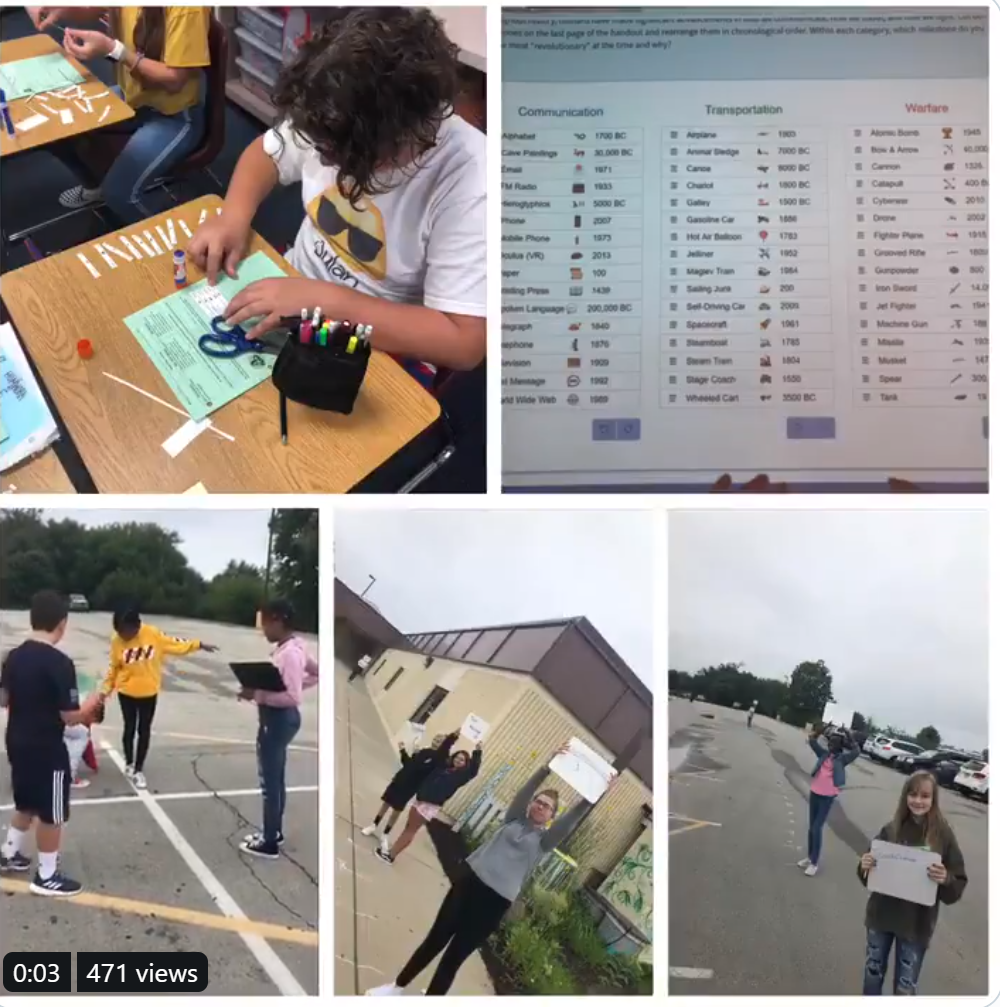
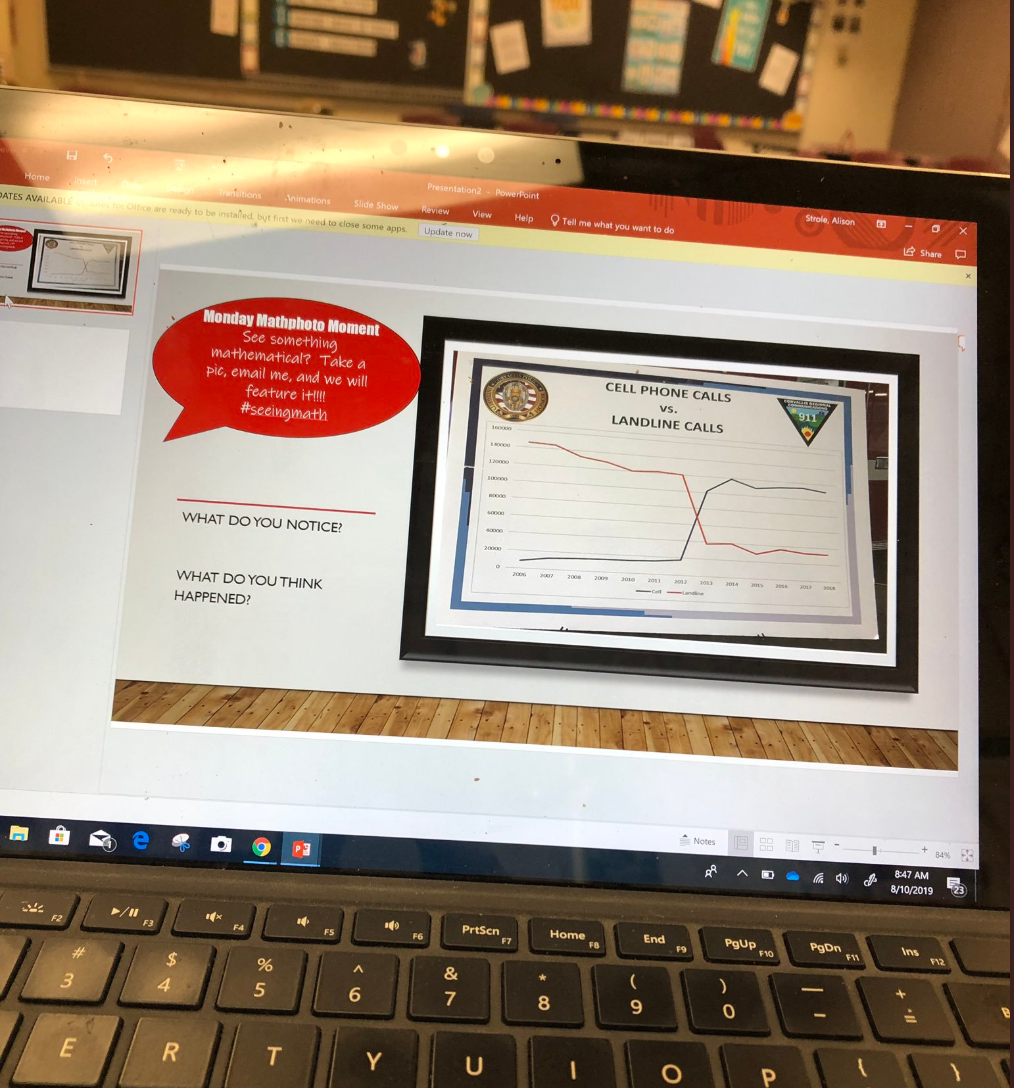
I wanted to find an activity that would tie into my first Monday Mathpic, get the kids outside, and help them to realize that integers play a role in their life, not just in math class. So I searched the various websites that are my go to places and found an activity called About Time. Our Monday Mathpic looked at the trends in 911 calls made with cell phones vs landlines from 2006 to 2018. This activity started with the kids watching the first iphone commercial. It then asked them to look at how humans have been making technological innovations throughout history – in communication, in travel, and in warfare. Over time, advancements from one milestone to the next have come more and more quickly. In the activity we modeled “before zero” years using negative integers. We then decided what an appropriate interval would be for our data set. Groups that didn’t choose wisely felt it in their legs by the end of the activity because they ended up doing quite a few squats. For example one group had to make a number line in the parking lot that spanned from 300,000BC to 2012. They decided that they wanted to go every 1,000 years as their interval. I asked them multiple times if that was an interval that they really wanted to use. They repeatedly said yes, so I told them to use it. About halfway through their number line the group called me over saying how sore their legs were. I said, I can only image… you are having to do lots of up downs to draw and write in the years. At that exact moment, I saw the light bulbs go off, “so that’s why you kept asking us about our interval selection? Next time we make a number line we are going to pay attention to the data more closely.” We then ordered and positioned the milestone innovations on our number line. Finally we found the difference between the integers and saw why we keep change change on subtraction. I was hoping that the students would see a connection, actually feeling a connection was an added bonus!
For years I would always give my students an end of course survey and ask them to strongly agree – agree – no opinion – disagree – or strongly disagree on a various list of questions about the class. Sample items were:
Mrs. Strole did a good job of making me feel comfortable with asking for help.
The notes in this class were useful.
The activities in this class helped me to better understand the material.
The review sessions before tests and quizzes were helpful.
If I am absent it was easy to find missing assignments.
After taking this class, Mrs. Strole has helped me to see the relevance of math in my own life.
I would always get agree or strongly agree for every question except for one. The students were not seeing the relevance of math in their own life. I was so disappointed because algebra and algebraic thinking are hidden all around. I had thought that I was doing a good job of highlighting that. So a couple of years ago I made it my mission to help my students to see math. I made a conscious effort to pick activities that matched up with their interests as well as had algebraic concepts that we were studying hidden in them. I always end up with lots of basketball players in my classes so I started our march madness bracket challenge and found a desmos activity that correlated a basketball shot to a quadratic function. During all of this I read Instant Relevance by Denis Sheeran and I was even more determined to make this happen. My results got a little better, but I was still under 50% of students who saw the relevance of math in their own life. Now if you know me I’m a very competitive person so this was not acceptable. I was just going to have to be more determined.
#seeingmath is born
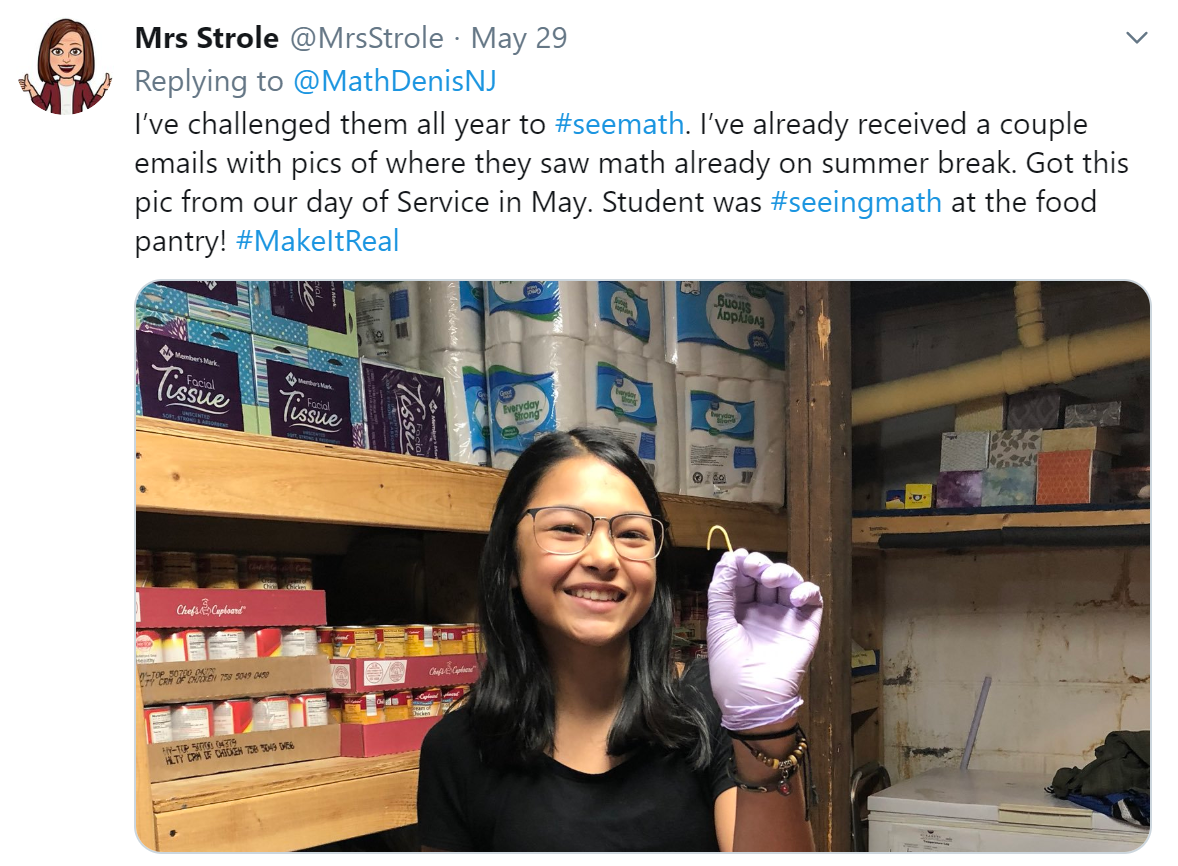
Last year, I started the #seeingmath hastag and tried to tweet out weekly activities that we were doing. The students started following. They would comment if I didn’t post any pics with them in it for a couple of weeks in a row. Students would say, “hey Mrs. Strole you should tweet this. This shows that exponential functions and tennis ball bounces relate.” Somehow, I had found a gold mind. I was running with it. Before Spring Break I challenged students to take selfies with any type of function that we had studied, when they saw it out in “real life.” I told them that we would highlight the quadratic functions that they found after break, since that was the unit that we were in. Over spring break, I tweeted every time we saw quadratics on our drive down to Florida. For their Seeing Algebra Showcase last year I opened up what the students could do for their showcase. I also explained that this year elementary students would be coming over to see what we were doing. A group of students said that they wanted to write children’s books using their selfie’s from spring break and then add to it. They said that way the elementary students would start to see that math is all over the place. My teacher heart exploded!!!!! The students did just that, they shared their books with the first, second, and fourth graders. One little first grader said during the Q&A with my student after they heard the book, “I’m never going to look at the McDonald’s sign the same. Now I know those are parabolas!” Their teacher emailed me later that day, to let me know that one of the boys in her first grade class said that if he had “infinite thumbs that’s how many he would use for today.”
So at the end of the year, I gave the kids that same survey. I crossed my fingers that they had started to see the relevance of the math in their own lives. I waited for all the survey monkey results to come in and then I did a happy dance. 85% of the students said they agreed or strongly agreed.
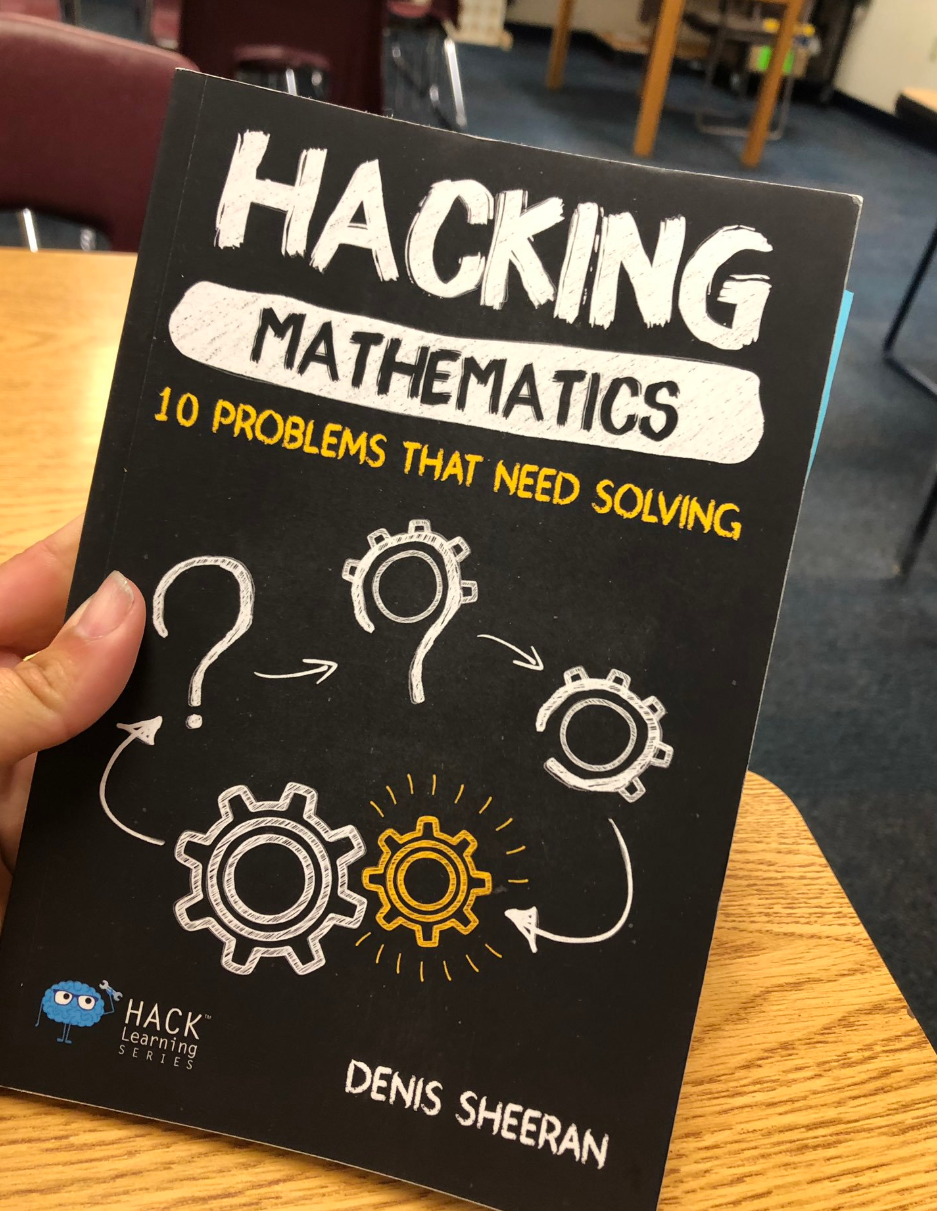
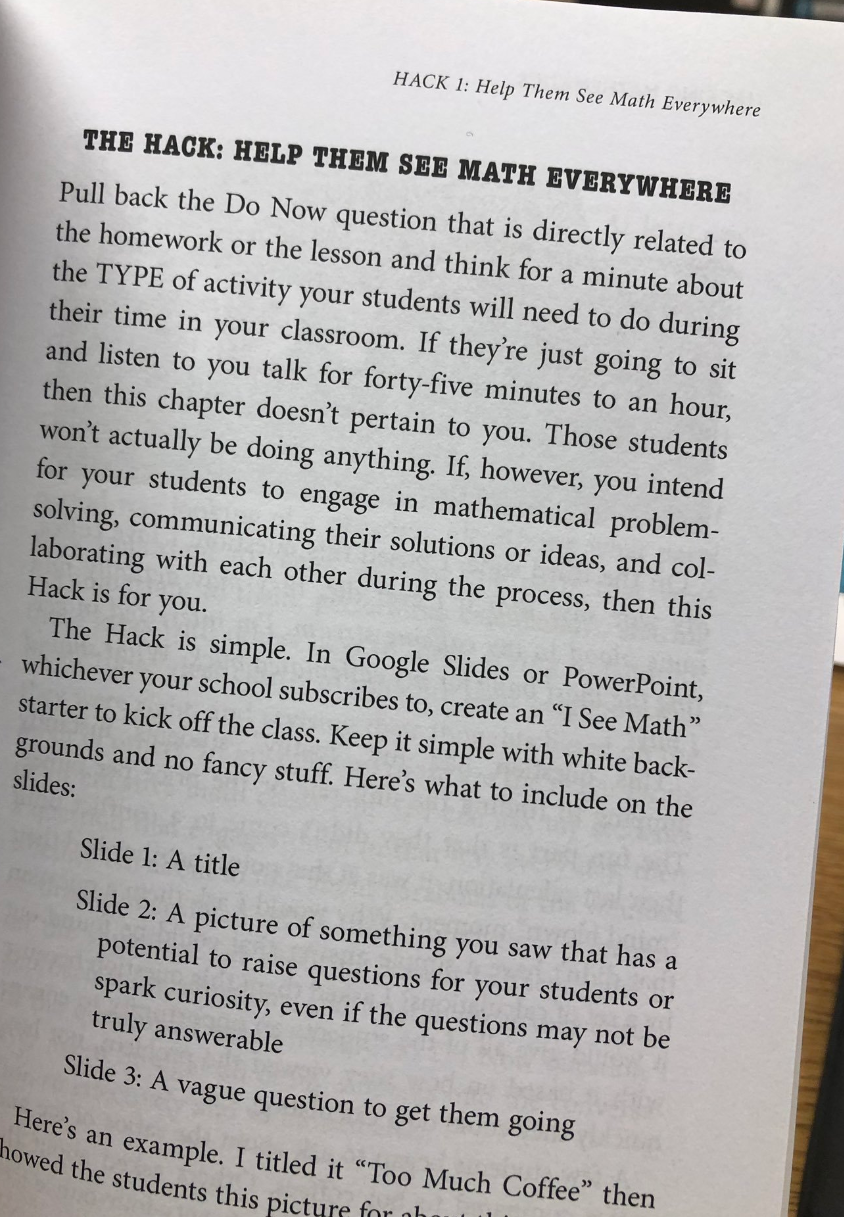
Now I’m determined to get 100% but I was ex tactic with those results. However, if you know me you know my competitive juices kicked back in and wanted to figure out how I could get to 100%. So over the summer I made it my mission to read and read and read and read. One of the books that had to be on that list was Denis Sheeran’s new release Hacking Mathematics. The first chapter had me hooked.
I also knew how much the #seeingmath tweets got the kids invested. Then I reflected on that fact that if the students hadn’t done the selfie challenge over spring break then that group would not have wanted to write the children’s books. So I came up with my take on Chapter One. I am going to do Monday Mathpic Moment. This week I am posting a graphic that was posted in a window. We are going to look and see what we notice and why we think it happened? Then I plan to collect data from all of my classes to see if our class data supports the graphic. Little do they know that on Wednesday we are going to look at the history timeline of technological innovations throughout history in communication with the telephone making many appearances as we review integer operations. My challenge will then be for the students to start taking a pic anytime they see something “mathematically interesting” out and about in their lives, email it to me, and hopefully it won’t just be me contributing to the Monday Mathpic Moment. I will update you later in the year to let you know if this was a two thumbs up or two thumbs down idea. I am hopeful it with be an “infinite” thumbs up idea and get the kids #seeingmath everywhere!
I started my 17th year of teaching. At the beginning of my teaching career I was so concerned with going over every rule, procedure, and expectation on day one to make sure the kids knew exactly what to do and how the class will run. However, as the years have passed I have realized that students rarely remember anything that you say on that first day, but they do remember how they felt. Did they think the teacher was nice? Did the room feel welcoming? Did they have fun? So over the last couple of years I have been very intentional with what activities I plan for the first couple of days. I have gotten much better at still laying the ground work for a successful year and what my expectations of them are, but in a more fun and engaging way. Every year, I go to bed the night before the first day with butterflies in my stomach as I nervously await to see if plans will fill the time and get the desired results. This year was no different.
I start off class with a round of Get To Know You Jenga. I challenge the class to see if they can make it through the entire class without knocking over the Jenga board. I love this because it incorporates problem solving as well as risk taking. The class comes together rooting on each person to successfully pull out the Jenga piece and lots of collaboration and communication as they give “suggestions” on which piece to pull for the best chance of success. Once they pull out the piece there is a question that they must answer before they can place their piece back on top. I learned this year that lots of my students want to move to warmer states like Florida or Hawaii. I have several students who enjoy biking (a great piece of knowledge that I can use later in the class to spark their love of math as we incorporate their love of biking). I have students who love Italian food as much as I do. However, my favorite response of the day came from a young lady who said that if she won a million dollar prize she would use it to help the homeless people in the state and then use whatever was left to help out her family members that are struggling. What a huge heart and another piece of information that can be tied into future math lessons.
From here I introduce myself as the number six. I tie in all the ways that the number six best represents my life. I then challenge the students to start brainstorming what number best represents them and how could they display that number in a visual way. On Friday we will pick back up on this assignment, when we head to the computer lab to start putting their ideas together for their My Life As A Number Project. In less than 10 minutes we have began to build a sense of community. They have learned more about their classmates and their teacher, and I have learned so much about their passions and interests which will help to guide their math journey this year and my ultimate goal of helping them to #seemath and see the relevance of math.
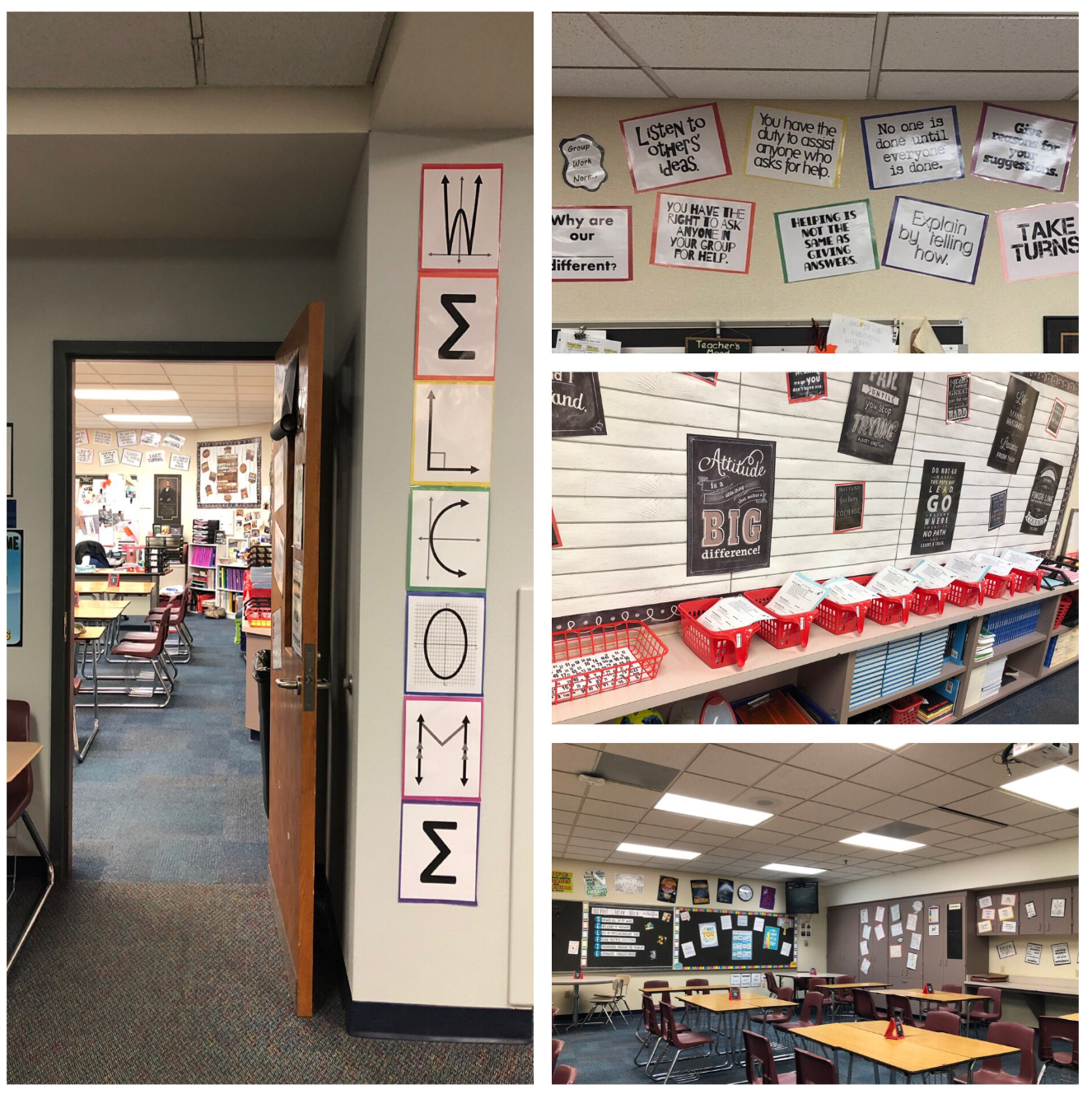
With the last twenty minutes of class we dive into our puzzle challenges. In math class this year we are going to do lots of group work. What better way to get them into the habit than by starting with group work on the first day. We set our group work norms and then the kids dive in. Most of these kids come in thinking that math is mainly computation. Now computation is a very important key to mathematics and poor computational skills will lead to other issues down the road, but my goal is for students to realize they aren’t just human calculators. Math is about risk taking. Math is about problem solving. Math is about collaboration. Math is about communication. Math is about perseverance and learning from failures. Math is about looking for and finding patterns. Each of the challenges the students will be participating in over the first two days of school force the students to work on each of these skills. Plus throw in some friendly competition (winning group earns the first Strole Bitmoji Badge of the year) and the kids are ready to go! Most groups only made it through 1 or 2 of the challenges today. Tomorrow they will get to come in and tackle the rest of the challenges for the entire period. Prizes are awarded at the end of each period on day2!
Challenge #One: 1 to 100 challenge. In this challenge students are given a paper with the numbers 1 to 100 mixed around the page. Each person in the group picks a different crayon from the box. The first person finds the number one and shades it in. The second person finds the number two and shades it in. The third person find the number three and shades it in. The fourth person finds the number four and shades it in. Then the first person finds the number five and shades it in. The second person finds the number six and shades it in. This continues until all 100 numbers have been shaded in. However, the fastest groups are the groups that find the pattern. After four or five rounds you could see the light bulbs go off, the groups huddled together, they whispered their observations to each other so no other group could steal their idea, they tested it, and once they realized it worked they were off and oh so proud to raise their hands when they finished and they beamed with pride as they completed their first “defend it” which is really just where they have to explain to me how they were able to beat the other groups using mathematical words and steps.
Challenge #Two: The Square Challenge. In this challenge students are given a baggie with five puzzle pieces and they are challenged to create a square. If they can make the square using four of the five pieces they will receive all 15 points. However, if they can make a square using all five of the five pieces they will receive 5 bonus points and thus making their chances of winning the entire challenge that much better. However, using all five pieces is much more challenging. I loved watching as the various groups tackled the problem. Some decided to start with the four out of five challenge and ensure that they received points. In this challenge, the group members really had to listen to each others ideas. There was LOTS OF FAILURE as they attempted multiple combinations until they finally found the correct grouping. Then other groups showed great risk taking as they went for the five out of five bonus challenge. This risk took lots of time, with no guarantee of any points. I loved learning which of my groups were the risk takers and which liked to play it safe.
Tomorrow groups will finish up the challenge as they tackle the multiplication with a twist activity which requires them to figure out what symbol pairs with what number. They are given 11 symbols and are told that they must match to the numbers 0 – 12. The symbols are used to make multiplication statements. This challenge will really ask them to use their computational skills, however, they will then have to look for patterns and problem solve. I love watching as the students use process of elimination (or really perseverance in failure) to start to piece the symbols with the numbers.
The final challenge is the match my image challenge. In this challenge the students are given a bag of dominos. Once student gets to walk up and take a “sneak peak” at the image I created with the dominos. The person who walks up and looks is the person who will then have to communicate to their group members how to recreate that image. They can not touch the dominos themselves. Each time that they come back up for a “sneak peak” they will lose one point from the total points possible. However, having me check the image and it being incorrect will result in a three point deduction. This challenge will force the group to pay attention to detail, be awesome communicators but even better listeners. This challenge is always one of my favorites to watch! There is always hair pulling, laughter, screams of frustration, and eventually dances of joy!
After doing variations of these challenges over the last couple of years. I will never go back to the old way. I have time to teach them about where to pick up papers and turn them in over the first two weeks. I can’t ever get back that first impression of my class. I can never get the “buy in” to the class that I get during the first week of school. I teach both the honors level algebra class as well as the remediation class. My Honors Algebra students are normally easy to please. They love the puzzles and challenges, but they also tend to love math already. This year will be all about pushing them further than they have ever gone and getting them to be mathematical thinkers and problem solvers, rather than regurgitation and computational experts. However my favorite comment of the day came from my remediation block class when a student came up at the end of the second period (I have this group for two periods back to back) and said, “I never thought I would enjoy having two periods of math. But today was actually fun Mrs. Strole. I’m ready to come back tomorrow!” Now that’s a win in my book!” By the end of the year, I’m determined to get the word “actually” out of the statement. That student will say math is fun!!!
Below are the 1 to 100 challenge paper as well as the template for the square challenge puzzle.
We are nearing the end of our summer book study. We are currently reading Dare to Lead by Brene Brown. The book has really asked me to be reflective about my leadership abilities and values both as a teacher and coach, as well as the qualities that I most admire about the leaders that I respect and the qualities that I promised I would never possess if I were in a leadership role.
In Part 2 and 3, Brene challenges us to determine two, not ten core values that we lead by. She provides us with a list of over one hundred values. I started by going through the list and marking any of the values that spoke to me. Then I went through and color coded the values that I saw as being in the “same” family. From there I narrowed it down to the two values that, in my opinion, were the root of all the other values that I felt strongly about. Those that know me would likely not be surprised by my 2 core values. I quickly realized that these two values have shaped my entire life from playing sports, growing up in a middle class blue collar family, to my own teaching and coaching.
Here is my “narrowed” down list… I’ll let you try to guess which two came to the surface as my two core values. I am confident that my department and principal know my two core values. My List: accountability, authenticity, commitment, curiosity, excellence, fairness, faith, family, friendship, gratitude, growth, integrity, leadership, learning, perseverance, reliability, respect, responsibility, sportsmanship, success, trust, understanding, usefulness, and wisdom.
I have quickly come to realize that I am not a “yes” person, I never have been, and I have to fight my instinct to judge when I feel like someone else is. I was always taught growing up to inquire, question, and search to understand before going along with something. I have always encouraged these same traits in my own children, students, and athletes. To me questioning is a sign of understanding, but often I feel as though some people in power can see it as a sign of disrespect or distrust. As a teacher or coach, I get excited when my students/athletes question because it means they are invested and engaged. They are seeking more knowledge and understanding and only true growth can come from that. This is what made it such a harsh awakening when I came across my first coach, in college, who saw me asking for more clarification and explanation about a change in my mechanics as something that needed to be “broken” rather than encouraged. It was at this exact moment that I swore I would never be that type of a coach. I lost all of my trust in her.
In that moment, the coach had the chance to build trust between us, to find out why I cared so much, or to put up her armor and build a wall that eventually became too high to climb. As I have moved on as an adult and have had many bosses along the way, I have quickly come to realize that listening and trust are the key components to being a leader who is able to to successfully lead their organization. Brene Brown defined it eloquently when she wrote, “trust is choosing to risk making something you value vulnerable to another person’s actions. Distrust is deciding that what is important to me is not safe with this person in this situation.” Without trust, your organization won’t be brave enough to have the tough conversations, to question and reflect, and eventually reach decisions that will make a true impact.
Brene Brown used the Marble Jar Analogy to describe how to build or lose trust. Research shows that TRUST is earned in small moments. However, I am an action person so the next step was my favorite part of her analogy. She outlines 7 behaviors that define trust (BRAVING):
Boundaries- respecting boundaries and when not clear being ok with asking and willing to say no if they go against your values.
Reliability – do what you say you’ll do
Accountability – own your mistakes, apologize, and make amends
Vault – don’t share information that is not yours to share
Integrity – practice values instead of talking
Nonjudgemental – able to ask for help without judegement
Generosity – extend the most generous interpretation possible to the intentions, words, and actions of others
She then goes on to challenges us as a reader to be reflective and define one or two observable behaviors for each of the seven elements. I have used this strategy before in coaching. We would come up with a quote for the year that “defined” our mission for that year. Then we would list behaviors and expectations that all the players and coaches would practice for the year in order to meet these goals. I definitely need to get better at doing this with my classes. We have a few basic that we hold to each year, but I could work on allowing flexibility in those and allowing the students ownership in those during our “get to know you” activities and journal responses that we focus on at the beginning of the year.
In my opinion, this has been doable for me as both a teacher and coach because it is on a small scale. I know the people I am leading, I have built a relationship with them, I listen when they question, we re-visit and re-vise as necessary. We build that trust together. They can see that my actions speak louder than my words. However, as an organization gets larger you have to be intentional in your trust building and you have to put it as a priority.
One of the easiest ways to build trust, is to first sit down and listen. As organizations get larger, it is so easy to forget this. The people you are leading are numbers and not people. You don’t know their names and definitely don’t know their values. I most respect the leaders who come into an organization and are brave enough to first sit back and listen, observe, make connections, get to know the key values. I most admire our association president. She knows every single name of every single teacher in our district, and our district is large. She takes the time to build that trust in those small moments. I remember, the days when I could walk into central office and I knew the name of every person in leadership and they knew my name as well. Those days have long since passed. We have become too big (or it is no longer a priority). However, this small moment has the ability to shape my views on decisions made and initiatives pushed out. Too often though, people coming in don’t take the time to build this trust. They don’t take the time to listen and thus walls go up and instead of working together to move the organization forward you are spending all your time trying to fix the cracks in those walls.
So here I am being brave. It is taking a lot of courage for me to continue to show up, ask questions, be a part of the conversation. I am an introvert at heart. I need that trust to be vulnerable and put my opinions out there. I don’t know many of the people when I walk into a room. I definitely don’t know the people who are taking the time to read this blog. Will these people see my questions as a positive or a negative? I have to hope that they are more like me and not my college coach. Often times, I feel as though it would be so much easier to just stay at home and not put myself out there, but that would go against who I am. I am a person of integrity and to be a person of integrity you must be willing to practice your values, not just professing them. So I will continue to walk the walk and not just talk the talk.
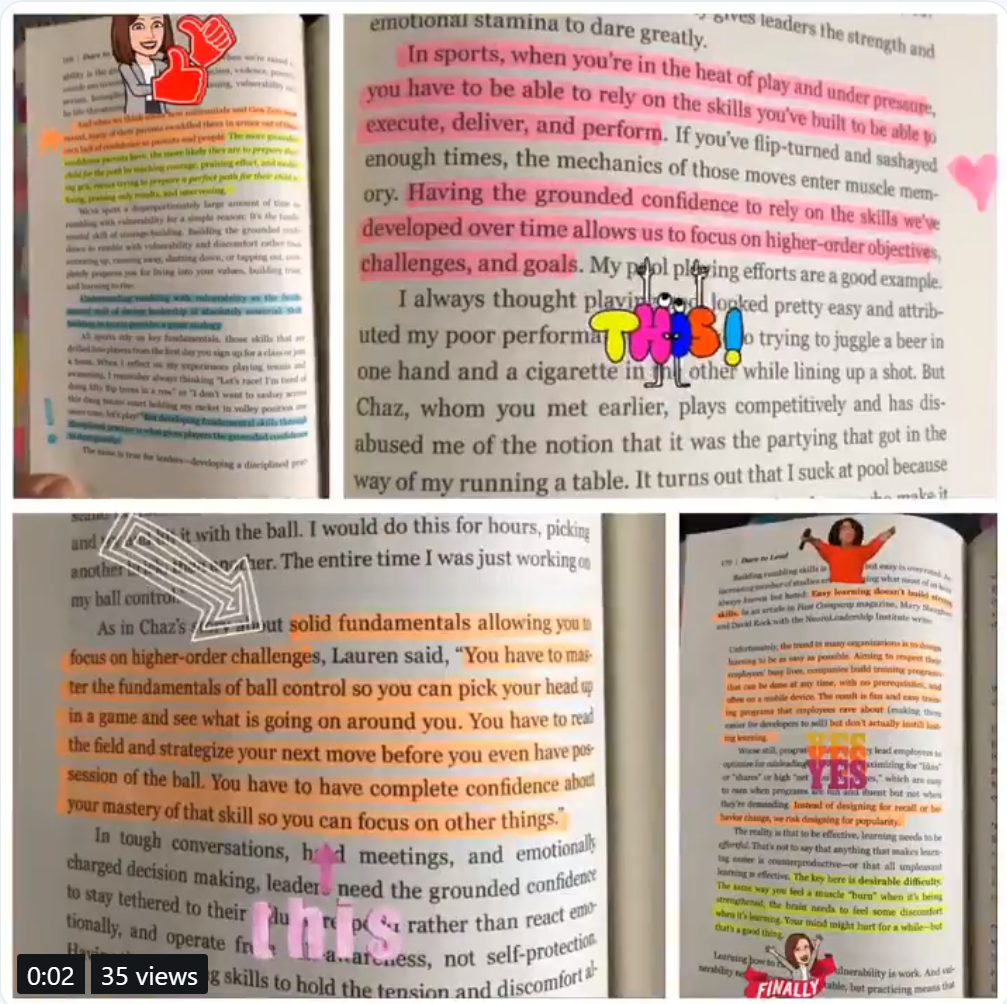
Have you every read a chapter of a book and felt like the author wasn’t writing to an anonymous someone, but rather they were writing this message directly to you?! Well that is exactly what happened when I opened up Dare to Lead today by Brene Brown. I was ready to read Part One: Section Five and to be honest I have been enjoying the book but haven’t necessarily been seeing how it could directly relate to my math classroom next year. (This is understandable, since the book is written to be about leadership in the corporate world. Despite what many would like to say, education is not a corporation and shouldn’t be run like one. However, leadership is leadership, whether it is the CEO of a company, the principal of a school, the coach on a field, the teacher in a classroom, or the parent at home.)
Well, on cue, the author said, “I’ll show you!” The chapter started out with the following quote: “Who we are is how we lead.”
I would change it to “Who we are is how we teach.” It then went on to say the focus would be on curiosity and grounded confidence. I was hooked. These are key pillars in my math classroom.
And here is where I literally feel like the author was saying, Alison pay attention, I’m writing this chapter for you!
“The more grounded confidence parents have, the more likely they are to prepare their child for the path by teaching courage, praising effort, and modeling grit, versus trying to prepare a perfect path for their child by fixing, praising only results, and intervening.” …
She was speaking to my parent heart. I am one of those parents who believes that kids need to learn lessons the hard way. If you forgot your homework at home, I’m sorry, you’ll have to take the zero or figure out a way to get it done, but I’m not getting class coverage to run home and bail you out. If you are on a team and don’t like the amount of playing time you are getting, then you need to talk to the coach yourself, ask what they see are areas of weakness to focus on and put in the work. And after every game or test grade, I have these simple questions for them, “Did you try your best and have fun? Learn something? Is there anything you think you need to change for the next time?” And I always end it with how proud I am for their effort, not the end result.
“Understanding rumbling with vulnerability as the fundamental skill of daring leadership is absolutely essential. Skill building in sports provides a great analogy.” … But developing fundamental skills through disciplined practice is what gives players the grounded confidence to dare greatly.”…
She was speaking to my math teacher heart. The math classroom is a place where people have to be able to grapple with vulnerability. I stress to my students that in order to tackle the more complex problems, students must first be able to have a strong command of their basic skills and have confidence in number sense. She goes on a few pages later to state that we must have “desirable difficulty.” The same way you feel a muscle “burn” when it’s being strengthened, the brain needs to feel some discomfort when it’s learning. I tell my remediation students this is called productive struggle. If we can work through it, then we will start to grow!
“In sports, when you’re in the heat of play and under pressure, you have to be able to rely on the skills you’ve built to be able to execute, deliver, and perform. Having the grounded confidence to rely on the skills we’ve developed over time allows us to focus on higher – order objectives, challenges, and goals.”
She was speaking to my coach heart. I often tell my softball girls during pitching lessons that you have to do the drill work so many times that you do it in your sleep without thinking. I then go on to tell the story about how when I was 16 years old I tore my ACL. I went in to work with the physical trainers after surgery and one of the tasks I was asked to do was sit on a rolling stool. I was to then put my right foot (the knee I tore) out in front of me and then use my muscles to pull the chair up to my foot as my knee went from straight to bent. Each time I did the drill and in the middle of the drill, my right arm would immediately shoot up next to my ear. The therapist would ask me what was going on and I replied that I honestly had no idea. We would do the next set and it would happen again. She said are you sure everything is alright? I replied with, I think so. On the next rep she said try to focus on not letting your arm go up. I agreed and went to do the next rep, despite me telling my arm not to do it, it went up again. I was starting to get worried that the doctor had done some re-wiring during surgery that wasn’t supposed to happen. Eventually, we figured out that when I got into a certain position it was mirroring the same “feel” to my body and muscles as my pitching motion as so by instinct my body got the rest of me into proper pitching motions. I had built those fundamental skills and muscle memories so that during the big games whether they were during travel season, high school semi – state, or a Big Ten game at IU I never had to worry about making sure I had my mechanics down… I could focus on the higher order goals and tasks at hand in the heat of competition. I had built that grounded confidence in the hours upon hours of skill development.
And then she dropped the mic. My heart was 10 sizes bigger because she had not only hit on my core beliefs as a mom (leader), coach (leader), but now was definitely stating my core beliefs as a math educator (leader).
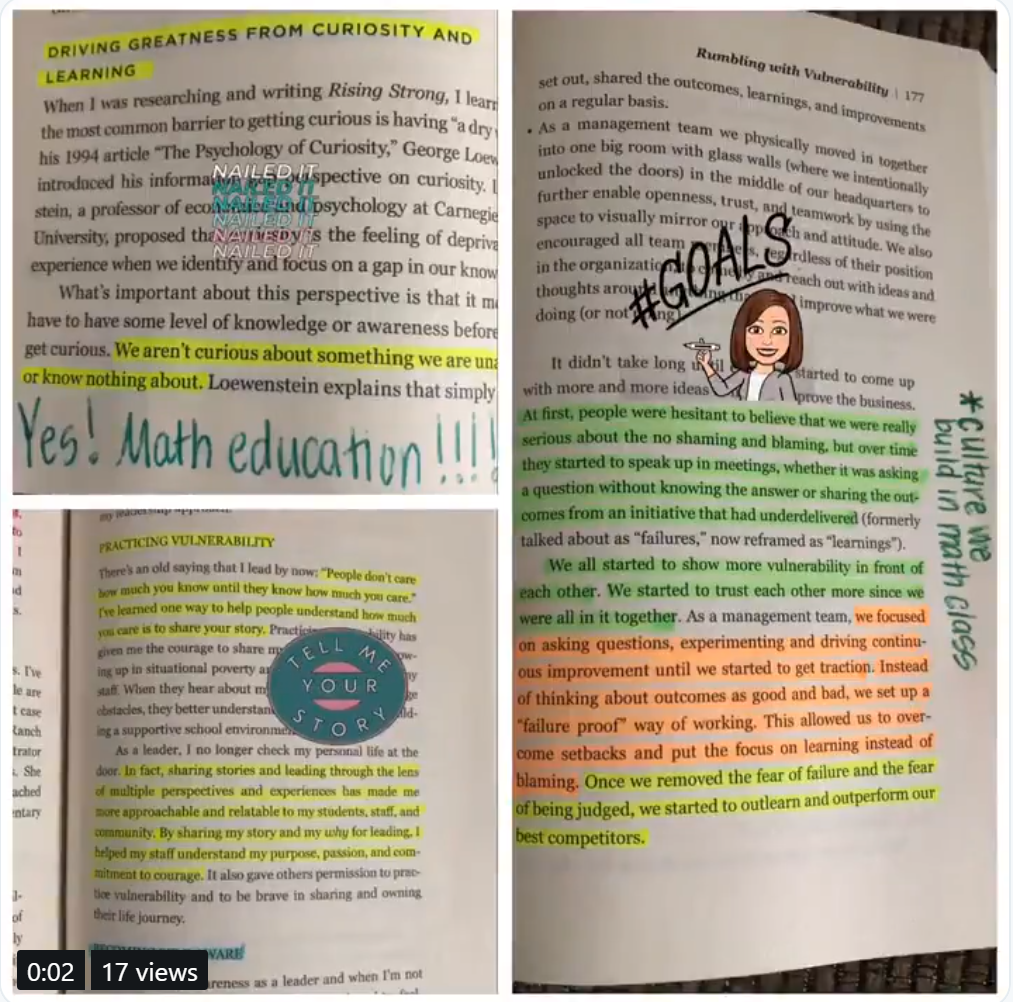
First she stated, “We aren’t curious about something we are unaware of or know nothing about.”
I always tell me students that you don’t know what you don’t know. It is my job as a math teacher to open your eyes to new concepts, give you the skill set you need to be curious, make sure you understand the fundamentals of the core concepts, and then watch where you go. Students can’t find their “passions” and be “empowered” in their education if they don’t have the proper tools to first do that. My job is to make sure that they can get there.
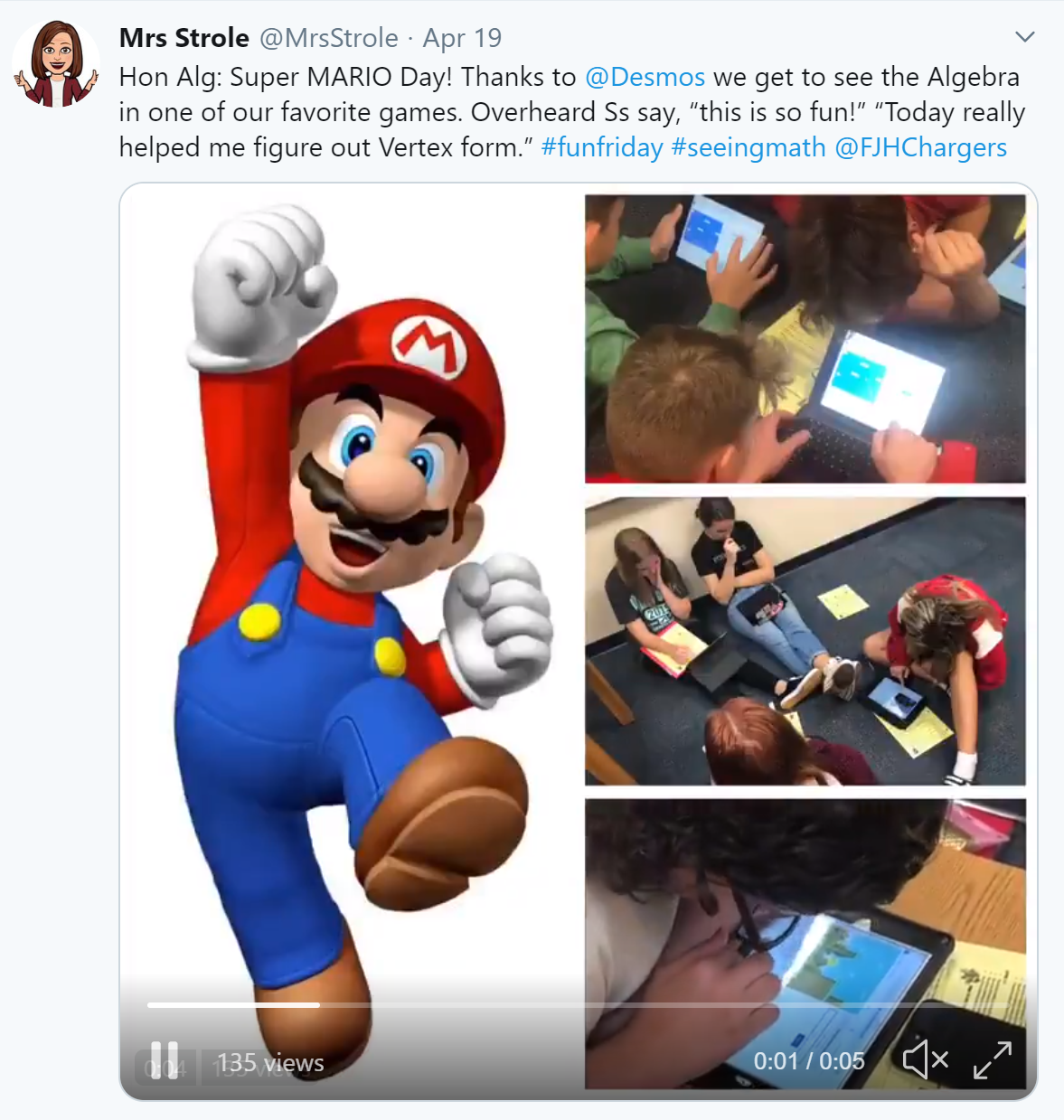
For example, in Honors Algebra I teach them about the various types of non – linear functions second semester with a focus on exponential and quadratic functions. We make sure that they understand the qualities that make these functions and the math behind it. Then we look to see all the places that the math is hidden in their lives. We investigated tennis balls to see exponential in action. We analyzed basketball shots to see quadratics in action. We found ways that the NCAA tournament and bracketology not only had probability hidden in it, but also exponential. We found quadratics in video games like Super Mario Brothers as well as famous pieces of architecture or cartoon characters. Each student then took their passion and used it in their end of course showcase piece. If I had done my job correctly, I had helped them to develop their skill set through disciplined practice, and now it was their chance to focus on higher – order challenges.
At the end of the year, students reflect on their learning. I had one student write the following, “Mrs. Strole I have always struggled with my free throw shots. After doing the basketball shot investigation in class, I went home and figured out where the axis of symmetry would be located. I then visualized making sure that my shot would hit it’s maximum height at that location of the driveway. Thank you for helping me to see how algebra could be used in my real – life (and for fixing my free throw shot).”
I had another student write the following, “Mrs. Strole a group of us had so much fun with all of the desmos activities that we made a group chat. When one of us figures out how to make a function we are studying do something new we will text it out to the whole group. When we were trying to create the birds, for angry birds, one of us figured out that we needed to square both the x and y variable. However, that made the bird be centered at the origin. So then I got the idea to use vertex form of a quadratic to help us move the circle to the sling shot and then —– figured out how to add a slider so that the bird could fly. We have also found youtubers that we watch to figure out new functions we can add to our project so that we can make more complex designs.”
These students would have never seen these connections or found these passions without first gaining the foundational skills needed. This then allowed for the curiosity to grow.
She then went on to write, “Once we removed the fear of failure and the fear of being judged, we started to outlearn and outperform our best competitors.” In this expert, the author was referring to something that Stefan Larsson said when discussing the turn around of Old Navy. However, this is the exact culture I work so hard to create in my math classroom. The students weren’t afraid of failure or being judged while they worked on their showcase piece. They were focused on the learning and their curiosity for what else they could create.
Thank you Brene Brown for so elequantly putting into words my “why”. If my principal ever does convince me to present at a conference, I promise you that pieces of this chapter will be found in that presentation!
Our district is reading Dare to Lead by Brene Brown. I have really enjoyed the book. I have found a lot of qualities of what a daring leader does and quickly realized that one of the main reasons I love my job, I love coming to work, and I love all of the amazing opportunities I have been given over the past several years is because I have daring leaders in my department chair Robin and in my principal Dr. Thorpe. I have been using Jed Dearbury’s suggestion from the Innovation Exchange this week and I have been doing a version of sketch noting as I read the book. It has allowed me to be more reflective in my reading. I have really enjoyed the process. I’m embarrassed that I hadn’t thought of it myself. I tell my own students to doodle so that they can draw connections to the math material, but I wasn’t practicing what I preach in my own life. Message received!!! However, taking the extra time to read, sketch, re-visit and reflect has also caused me to really struggle with a few of the passages. However, the one that has caused me to stop the reading and write this blog is found on page 106.
On page 106, the author writes the following:
“Daring Leadership models and supports rest, play, and recovery. If we want to live a life of meaning and contribution, we have to become intentional about cultivating sleep and play. We have to let go of exhaustion, busyness, and productivity as status symbols and measures of self – worth. We are impressing no one. What’s more, according to Brown’s research, play shapes our brain, fosters empathy, helps us navigate complex social groups, and is at the core of creativity and innovation. In some ways, it helps our overheated brain cool down. To weave this into office culture, leaders need to model appropriate boundaries by shutting off email at a reasonable time and focusing on themselves and their family. Do not celebrate people who work through the weekend, who brag that they are tethered to their computers over Christmas break. Ultimately, it’s unsustainable behavior and it has dangerous side effects, including burnout, depression, and anxiety – it also creates a culture of workaholic competitiveness that’s detrimental to everyone.”
I respect everything that she says… however, what I really want to scream is really?!?! Do you not live in the country I live in?! Do you not work in the district I work in?!
Don’t we live in a country that goes against everything in this statement?! As a teacher, I can’t tell you how many times I hear, oh you don’t work a real job… you only work 185 days (if only that were true). We value the employee who takes their work home and gets the job done. We encourage our athletes to take private lessons and play a sport year round if they want to, not receive a college scholarship, but if they want to make the junior high team. I, personally, make money giving pitching lessons for softball and most of my clients aren’t high school students looking for a college scholarship because I don’t have the time to dedicate to them since I also teach. However, my clients are 8 – 12 year olds who are taking lessons just so that they can make their rec league travel teams.
We say we value sleep, but my son is going to be a freshman in high school next year and he has football workout 4 days a week, every week for the entire summer starting at 7am. Once school starts, the baseball team will have off-season workouts that begin at 6am throughout the year that are “highly encouraged” if you want to play baseball for the school. I am not saying any of this is bad. I was a high school coach myself and we won two state championships during my tenure and I definitely asked this of my athletes. If I want to get everything done that I need to and not sacrifice family time, completely… I have to stay up well past my kid’s (and lots of time my own) bedtime in order to do everything that makes me a “highly effective” teacher/leader.
As a teacher in our district, we are encouraged to keep in contact with our students and their families, showcasing what is happening in the classroom, whether this is via social media, newsletters, phone calls, or emails. I do see the value in it and I do it, but this is not something that is done during work hours, it is done during family hours. We are encouraged to answer family questions in a timely manner and thus, I have my email set to alert me on my phone and I answer emails until 10pm (my bedtime). It is one of the things that parent’s say they most appreciate about me.
We are encouraged to be continually learning by participating in book studies, twitter chats, and going to conferences. The first week off of school this summer had me at the school 3 of the 5 days for conferences. I wasn’t surprised by the people I saw or didn’t see at these conferences. The district tweeted out about how great it was to see so many teachers learning from other teachers! I agree with this statement completely. However, I chose to give of valuable family time and rest and relaxation over summer break to participate in this conference. I had colleagues say that summer is a time to unwind and re-charge and that’s why they wouldn’t be going to the conference. Which is right?! Are we both right?! Are neither of us right?! Today, both of my son’s were scheduled to be in a baseball tournament, however, mother nature had different plans and we were given an unexpected day off. Everyone else in my family saw it as an opportunity to relax. I saw it as an opportunity to get more of Dare to Lead read so that I would be better prepared for our district’s Twitter Chat tonight.
I respect the author’s point of view… I just don’t see anywhere in my life where following her words are rewarded. I wish we lived in a culture that did, but in my opinion people keep getting asked to do more and more with less and less. I am hopeful that this passage is a topic of tonight’s twitter chat and I can’t wait to hear what thoughts other’s in the district have.
I was following along in the #MakeItReal twitter chat the other night and Denis Sheeran asked me if I had a blog. He then went on to encourage me to start one because he would be interested in reading it. I then met with colleagues in my district on Monday of this week to re-visit our 8th grade curriculum map and was telling them about how crazy it was that an author I admire had encouraged me to start blogging and how ridiculous it really was, because who would want to read what I had to say. What followed next was the push that I needed. My colleagues all said, in unison, “I would love to read your blog.” So here it goes.
I sat on the teacher evaluation group for our district two years ago. Last year, the new evaluation system went into effect and when I met with my principal to set my goals, she challenged me to get out of my comfort zone. Share what I do in my classroom with people outside of just our department. The year before I was able to take my remediation class to 100% pass rate on our state test and got 5 students to jump from failing in 7th grade to pass+ (the highest ranking) in one year. She then went on to say that I should start presenting at conferences. She knew that all of this was completely out of my comfort zone. However, I took what I felt like were giant steps, but I’m sure others felt like were baby steps. I started to tweet out multiple times a week about the things that we were doing in both my math8 remediation class as well as my honors algebra class.
What happened over the past year was unexpected. My students got really into the posts. They would get notified each time that I would post something. They would request that they were tweeted out. They took more time to craft their responses if they knew that they were going to be videoed for a post. My PLN group grew after I started posting. I found Twitter chats to join and not only did my students’ learning improve this year, but so did mine. Other math teachers’ from around the country started following me and re-tweeting my activities or including them in their blogs. The Indiana Department of Education highlighted one of my Honors Algebra projects in their High Ability May newsletter.
I still haven’t found the courage to present. But I am taking that next step by starting this blog. So welcome. I’m still not sold that people really care to read what I have to say, but I am making it my goal to blog, along with continue tweeting for the next school year.



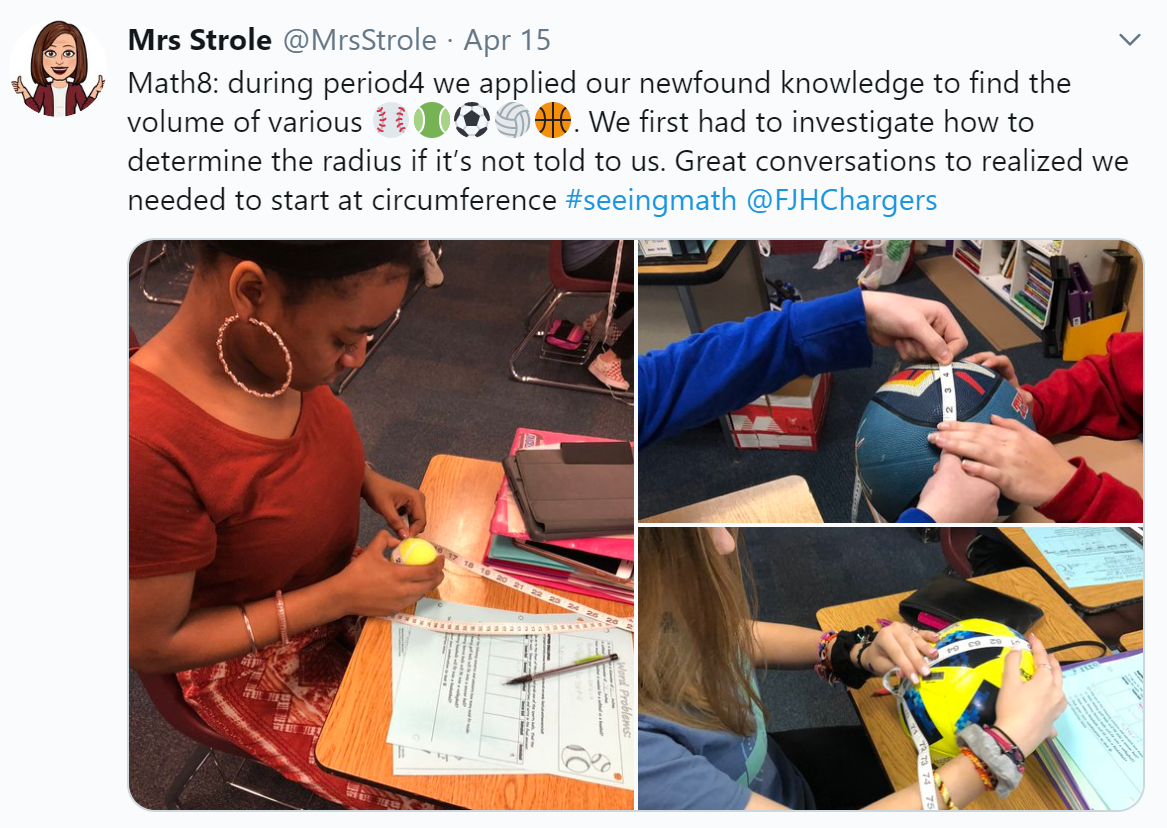

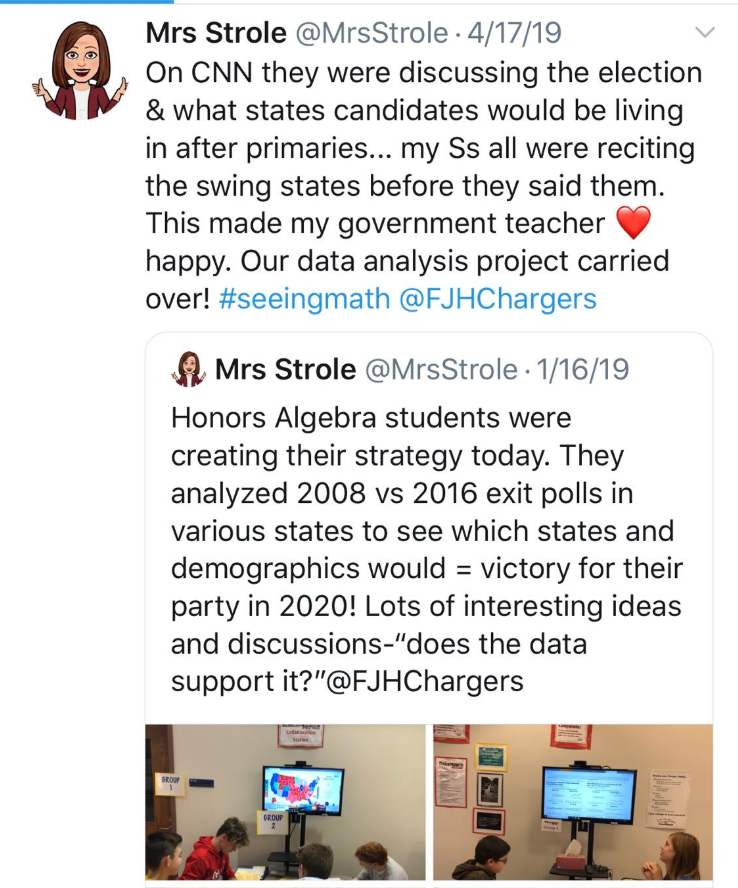
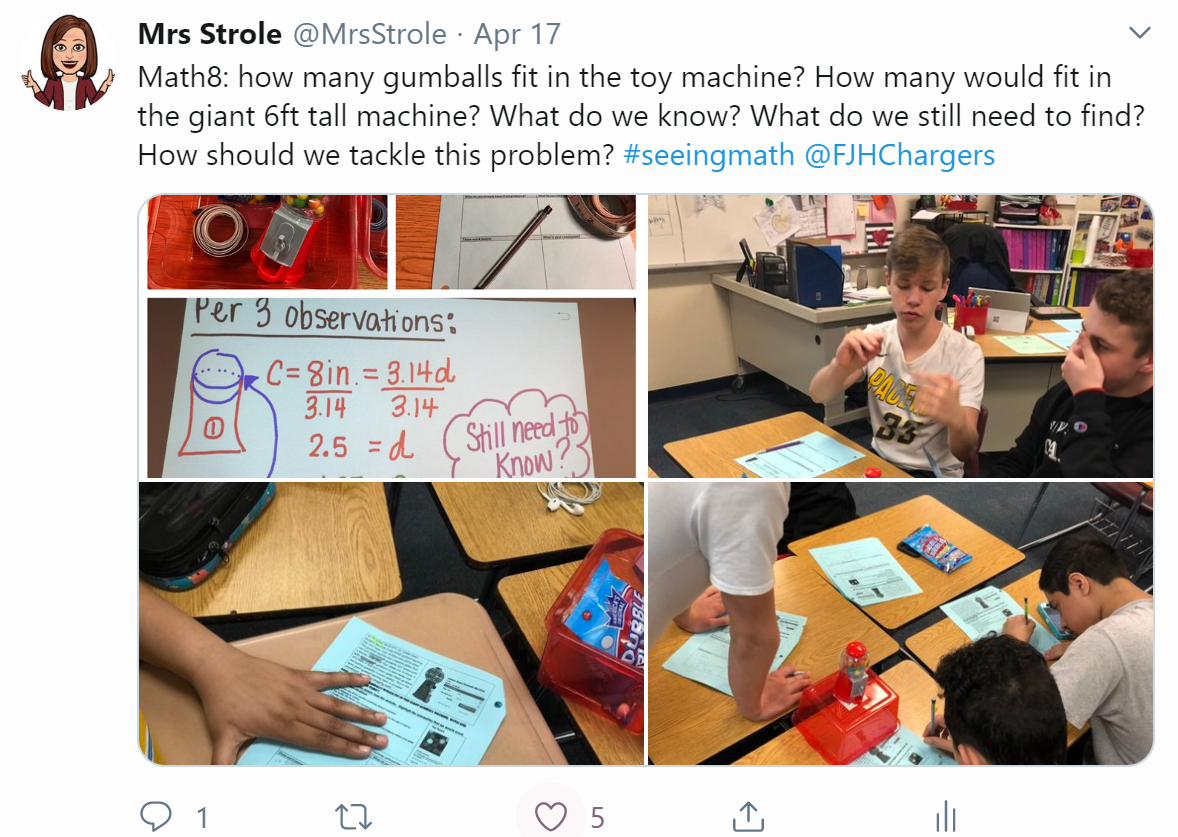










 #seeingmath with Mrs Strole