Listening to Lead

We are nearing the end of our summer book study. We are currently reading Dare to Lead by Brene Brown. The book has really asked me to be reflective about my leadership abilities and values both as a teacher and coach, as well as the qualities that I most admire about the leaders that I respect and the qualities that I promised I would never possess if I were in a leadership role.

In Part 2 and 3, Brene challenges us to determine two, not ten core values that we lead by. She provides us with a list of over one hundred values. I started by going through the list and marking any of the values that spoke to me. Then I went through and color coded the values that I saw as being in the “same” family. From there I narrowed it down to the two values that, in my opinion, were the root of all the other values that I felt strongly about. Those that know me would likely not be surprised by my 2 core values. I quickly realized that these two values have shaped my entire life from playing sports, growing up in a middle class blue collar family, to my own teaching and coaching.

Here is my “narrowed” down list… I’ll let you try to guess which two came to the surface as my two core values. I am confident that my department and principal know my two core values. My List: accountability, authenticity, commitment, curiosity, excellence, fairness, faith, family, friendship, gratitude, growth, integrity, leadership, learning, perseverance, reliability, respect, responsibility, sportsmanship, success, trust, understanding, usefulness, and wisdom.

I have quickly come to realize that I am not a “yes” person, I never have been, and I have to fight my instinct to judge when I feel like someone else is. I was always taught growing up to inquire, question, and search to understand before going along with something. I have always encouraged these same traits in my own children, students, and athletes. To me questioning is a sign of understanding, but often I feel as though some people in power can see it as a sign of disrespect or distrust. As a teacher or coach, I get excited when my students/athletes question because it means they are invested and engaged. They are seeking more knowledge and understanding and only true growth can come from that. This is what made it such a harsh awakening when I came across my first coach, in college, who saw me asking for more clarification and explanation about a change in my mechanics as something that needed to be “broken” rather than encouraged. It was at this exact moment that I swore I would never be that type of a coach. I lost all of my trust in her.

In that moment, the coach had the chance to build trust between us, to find out why I cared so much, or to put up her armor and build a wall that eventually became too high to climb. As I have moved on as an adult and have had many bosses along the way, I have quickly come to realize that listening and trust are the key components to being a leader who is able to to successfully lead their organization. Brene Brown defined it eloquently when she wrote, “trust is choosing to risk making something you value vulnerable to another person’s actions. Distrust is deciding that what is important to me is not safe with this person in this situation.” Without trust, your organization won’t be brave enough to have the tough conversations, to question and reflect, and eventually reach decisions that will make a true impact.

Brene Brown used the Marble Jar Analogy to describe how to build or lose trust. Research shows that TRUST is earned in small moments. However, I am an action person so the next step was my favorite part of her analogy. She outlines 7 behaviors that define trust (BRAVING):

  1. Boundaries- respecting boundaries and when not clear being ok with asking and willing to say no if they go against your values.
  2. Reliability – do what you say you’ll do
  3. Accountability – own your mistakes, apologize, and make amends
  4. Vault – don’t share information that is not yours to share
  5. Integrity – practice values instead of talking
  6. Nonjudgemental – able to ask for help without judegement
  7. Generosity – extend the most generous interpretation possible to the intentions, words, and actions of others

She then goes on to challenges us as a reader to be reflective and define one or two observable behaviors for each of the seven elements. I have used this strategy before in coaching. We would come up with a quote for the year that “defined” our mission for that year. Then we would list behaviors and expectations that all the players and coaches would practice for the year in order to meet these goals. I definitely need to get better at doing this with my classes. We have a few basic that we hold to each year, but I could work on allowing flexibility in those and allowing the students ownership in those during our “get to know you” activities and journal responses that we focus on at the beginning of the year.

In my opinion, this has been doable for me as both a teacher and coach because it is on a small scale. I know the people I am leading, I have built a relationship with them, I listen when they question, we re-visit and re-vise as necessary. We build that trust together. They can see that my actions speak louder than my words. However, as an organization gets larger you have to be intentional in your trust building and you have to put it as a priority.

One of the easiest ways to build trust, is to first sit down and listen. As organizations get larger, it is so easy to forget this. The people you are leading are numbers and not people. You don’t know their names and definitely don’t know their values. I most respect the leaders who come into an organization and are brave enough to first sit back and listen, observe, make connections, get to know the key values. I most admire our association president. She knows every single name of every single teacher in our district, and our district is large. She takes the time to build that trust in those small moments. I remember, the days when I could walk into central office and I knew the name of every person in leadership and they knew my name as well. Those days have long since passed. We have become too big (or it is no longer a priority). However, this small moment has the ability to shape my views on decisions made and initiatives pushed out. Too often though, people coming in don’t take the time to build this trust. They don’t take the time to listen and thus walls go up and instead of working together to move the organization forward you are spending all your time trying to fix the cracks in those walls.

So here I am being brave. It is taking a lot of courage for me to continue to show up, ask questions, be a part of the conversation. I am an introvert at heart. I need that trust to be vulnerable and put my opinions out there. I don’t know many of the people when I walk into a room. I definitely don’t know the people who are taking the time to read this blog. Will these people see my questions as a positive or a negative? I have to hope that they are more like me and not my college coach. Often times, I feel as though it would be so much easier to just stay at home and not put myself out there, but that would go against who I am. I am a person of integrity and to be a person of integrity you must be willing to practice your values, not just professing them. So I will continue to walk the walk and not just talk the talk.

Who We Are is How We TEACH

Have you every read a chapter of a book and felt like the author wasn’t writing to an anonymous someone, but rather they were writing this message directly to you?! Well that is exactly what happened when I opened up Dare to Lead today by Brene Brown. I was ready to read Part One: Section Five and to be honest I have been enjoying the book but haven’t necessarily been seeing how it could directly relate to my math classroom next year. (This is understandable, since the book is written to be about leadership in the corporate world. Despite what many would like to say, education is not a corporation and shouldn’t be run like one. However, leadership is leadership, whether it is the CEO of a company, the principal of a school, the coach on a field, the teacher in a classroom, or the parent at home.)

Well, on cue, the author said, “I’ll show you!” The chapter started out with the following quote: “Who we are is how we lead.”

I would change it to “Who we are is how we teach.” It then went on to say the focus would be on curiosity and grounded confidence. I was hooked. These are key pillars in my math classroom.

And here is where I literally feel like the author was saying, Alison pay attention, I’m writing this chapter for you!

“The more grounded confidence parents have, the more likely they are to prepare their child for the path by teaching courage, praising effort, and modeling grit, versus trying to prepare a perfect path for their child by fixing, praising only results, and intervening.” …

She was speaking to my parent heart. I am one of those parents who believes that kids need to learn lessons the hard way. If you forgot your homework at home, I’m sorry, you’ll have to take the zero or figure out a way to get it done, but I’m not getting class coverage to run home and bail you out. If you are on a team and don’t like the amount of playing time you are getting, then you need to talk to the coach yourself, ask what they see are areas of weakness to focus on and put in the work. And after every game or test grade, I have these simple questions for them, “Did you try your best and have fun? Learn something? Is there anything you think you need to change for the next time?” And I always end it with how proud I am for their effort, not the end result.

“Understanding rumbling with vulnerability as the fundamental skill of daring leadership is absolutely essential. Skill building in sports provides a great analogy.” … But developing fundamental skills through disciplined practice is what gives players the grounded confidence to dare greatly.”…

She was speaking to my math teacher heart. The math classroom is a place where people have to be able to grapple with vulnerability. I stress to my students that in order to tackle the more complex problems, students must first be able to have a strong command of their basic skills and have confidence in number sense. She goes on a few pages later to state that we must have “desirable difficulty.” The same way you feel a muscle “burn” when it’s being strengthened, the brain needs to feel some discomfort when it’s learning. I tell my remediation students this is called productive struggle. If we can work through it, then we will start to grow!

“In sports, when you’re in the heat of play and under pressure, you have to be able to rely on the skills you’ve built to be able to execute, deliver, and perform. Having the grounded confidence to rely on the skills we’ve developed over time allows us to focus on higher – order objectives, challenges, and goals.”

She was speaking to my coach heart. I often tell my softball girls during pitching lessons that you have to do the drill work so many times that you do it in your sleep without thinking. I then go on to tell the story about how when I was 16 years old I tore my ACL. I went in to work with the physical trainers after surgery and one of the tasks I was asked to do was sit on a rolling stool. I was to then put my right foot (the knee I tore) out in front of me and then use my muscles to pull the chair up to my foot as my knee went from straight to bent. Each time I did the drill and in the middle of the drill, my right arm would immediately shoot up next to my ear. The therapist would ask me what was going on and I replied that I honestly had no idea. We would do the next set and it would happen again. She said are you sure everything is alright? I replied with, I think so. On the next rep she said try to focus on not letting your arm go up. I agreed and went to do the next rep, despite me telling my arm not to do it, it went up again. I was starting to get worried that the doctor had done some re-wiring during surgery that wasn’t supposed to happen. Eventually, we figured out that when I got into a certain position it was mirroring the same “feel” to my body and muscles as my pitching motion as so by instinct my body got the rest of me into proper pitching motions. I had built those fundamental skills and muscle memories so that during the big games whether they were during travel season, high school semi – state, or a Big Ten game at IU I never had to worry about making sure I had my mechanics down… I could focus on the higher order goals and tasks at hand in the heat of competition. I had built that grounded confidence in the hours upon hours of skill development.

And then she dropped the mic. My heart was 10 sizes bigger because she had not only hit on my core beliefs as a mom (leader), coach (leader), but now was definitely stating my core beliefs as a math educator (leader).

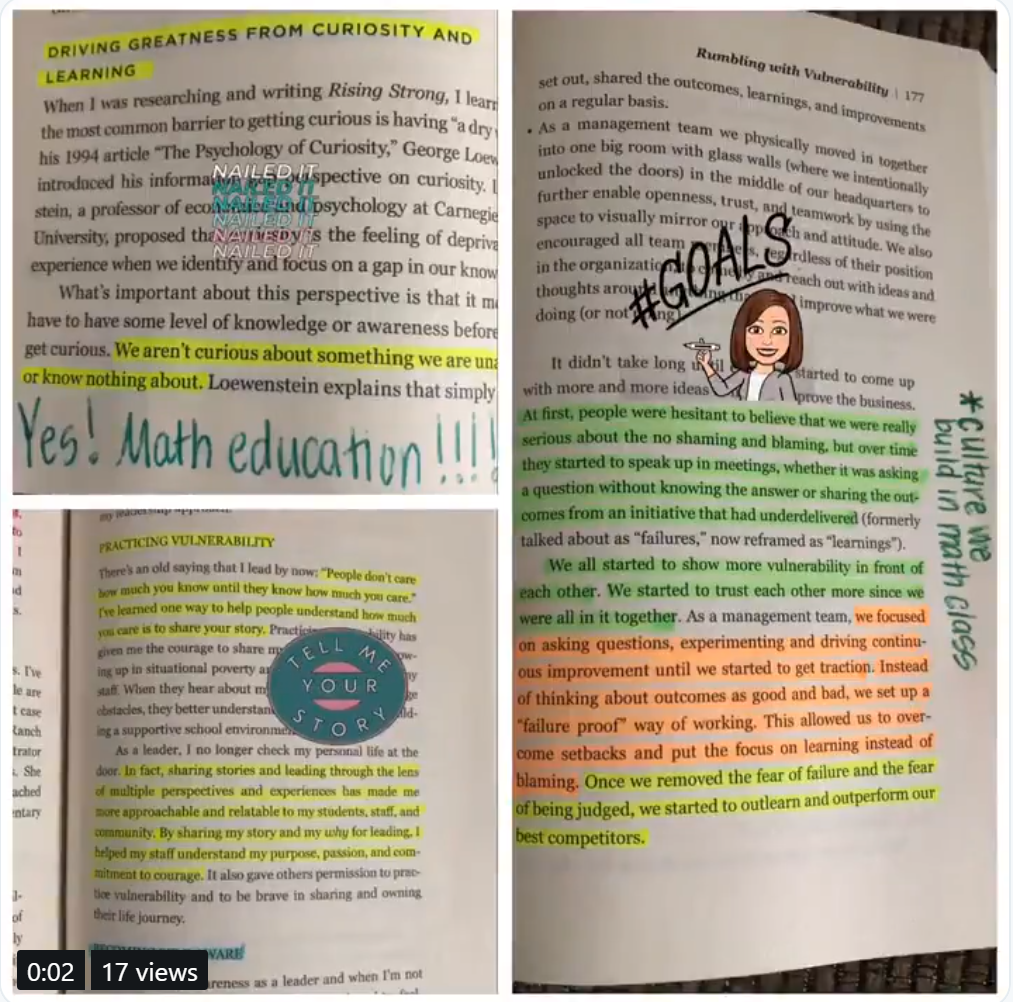
First she stated, “We aren’t curious about something we are unaware of or know nothing about.”

I always tell me students that you don’t know what you don’t know. It is my job as a math teacher to open your eyes to new concepts, give you the skill set you need to be curious, make sure you understand the fundamentals of the core concepts, and then watch where you go. Students can’t find their “passions” and be “empowered” in their education if they don’t have the proper tools to first do that. My job is to make sure that they can get there.

For example, in Honors Algebra I teach them about the various types of non – linear functions second semester with a focus on exponential and quadratic functions. We make sure that they understand the qualities that make these functions and the math behind it. Then we look to see all the places that the math is hidden in their lives. We investigated tennis balls to see exponential in action. We analyzed basketball shots to see quadratics in action. We found ways that the NCAA tournament and bracketology not only had probability hidden in it, but also exponential. We found quadratics in video games like Super Mario Brothers as well as famous pieces of architecture or cartoon characters. Each student then took their passion and used it in their end of course showcase piece. If I had done my job correctly, I had helped them to develop their skill set through disciplined practice, and now it was their chance to focus on higher – order challenges.

At the end of the year, students reflect on their learning. I had one student write the following, “Mrs. Strole I have always struggled with my free throw shots. After doing the basketball shot investigation in class, I went home and figured out where the axis of symmetry would be located. I then visualized making sure that my shot would hit it’s maximum height at that location of the driveway. Thank you for helping me to see how algebra could be used in my real – life (and for fixing my free throw shot).”

I had another student write the following, “Mrs. Strole a group of us had so much fun with all of the desmos activities that we made a group chat. When one of us figures out how to make a function we are studying do something new we will text it out to the whole group. When we were trying to create the birds, for angry birds, one of us figured out that we needed to square both the x and y variable. However, that made the bird be centered at the origin. So then I got the idea to use vertex form of a quadratic to help us move the circle to the sling shot and then —– figured out how to add a slider so that the bird could fly. We have also found youtubers that we watch to figure out new functions we can add to our project so that we can make more complex designs.”

These students would have never seen these connections or found these passions without first gaining the foundational skills needed. This then allowed for the curiosity to grow.

She then went on to write, “Once we removed the fear of failure and the fear of being judged, we started to outlearn and outperform our best competitors.” In this expert, the author was referring to something that Stefan Larsson said when discussing the turn around of Old Navy. However, this is the exact culture I work so hard to create in my math classroom. The students weren’t afraid of failure or being judged while they worked on their showcase piece. They were focused on the learning and their curiosity for what else they could create.

Thank you Brene Brown for so elequantly putting into words my “why”. If my principal ever does convince me to present at a conference, I promise you that pieces of this chapter will be found in that presentation!

The Struggle is Real

Summer Reading PD: Book #3

Our district is reading Dare to Lead by Brene Brown. I have really enjoyed the book. I have found a lot of qualities of what a daring leader does and quickly realized that one of the main reasons I love my job, I love coming to work, and I love all of the amazing opportunities I have been given over the past several years is because I have daring leaders in my department chair Robin and in my principal Dr. Thorpe. I have been using Jed Dearbury’s suggestion from the Innovation Exchange this week and I have been doing a version of sketch noting as I read the book. It has allowed me to be more reflective in my reading. I have really enjoyed the process. I’m embarrassed that I hadn’t thought of it myself. I tell my own students to doodle so that they can draw connections to the math material, but I wasn’t practicing what I preach in my own life. Message received!!! However, taking the extra time to read, sketch, re-visit and reflect has also caused me to really struggle with a few of the passages. However, the one that has caused me to stop the reading and write this blog is found on page 106.

On page 106, the author writes the following:

“Daring Leadership models and supports rest, play, and recovery. If we want to live a life of meaning and contribution, we have to become intentional about cultivating sleep and play. We have to let go of exhaustion, busyness, and productivity as status symbols and measures of self – worth. We are impressing no one. What’s more, according to Brown’s research, play shapes our brain, fosters empathy, helps us navigate complex social groups, and is at the core of creativity and innovation. In some ways, it helps our overheated brain cool down. To weave this into office culture, leaders need to model appropriate boundaries by shutting off email at a reasonable time and focusing on themselves and their family. Do not celebrate people who work through the weekend, who brag that they are tethered to their computers over Christmas break. Ultimately, it’s unsustainable behavior and it has dangerous side effects, including burnout, depression, and anxiety – it also creates a culture of workaholic competitiveness that’s detrimental to everyone.”

I respect everything that she says… however, what I really want to scream is really?!?! Do you not live in the country I live in?! Do you not work in the district I work in?!

Don’t we live in a country that goes against everything in this statement?! As a teacher, I can’t tell you how many times I hear, oh you don’t work a real job… you only work 185 days (if only that were true). We value the employee who takes their work home and gets the job done. We encourage our athletes to take private lessons and play a sport year round if they want to, not receive a college scholarship, but if they want to make the junior high team. I, personally, make money giving pitching lessons for softball and most of my clients aren’t high school students looking for a college scholarship because I don’t have the time to dedicate to them since I also teach. However, my clients are 8 – 12 year olds who are taking lessons just so that they can make their rec league travel teams.

We say we value sleep, but my son is going to be a freshman in high school next year and he has football workout 4 days a week, every week for the entire summer starting at 7am. Once school starts, the baseball team will have off-season workouts that begin at 6am throughout the year that are “highly encouraged” if you want to play baseball for the school. I am not saying any of this is bad. I was a high school coach myself and we won two state championships during my tenure and I definitely asked this of my athletes. If I want to get everything done that I need to and not sacrifice family time, completely… I have to stay up well past my kid’s (and lots of time my own) bedtime in order to do everything that makes me a “highly effective” teacher/leader.

As a teacher in our district, we are encouraged to keep in contact with our students and their families, showcasing what is happening in the classroom, whether this is via social media, newsletters, phone calls, or emails. I do see the value in it and I do it, but this is not something that is done during work hours, it is done during family hours. We are encouraged to answer family questions in a timely manner and thus, I have my email set to alert me on my phone and I answer emails until 10pm (my bedtime). It is one of the things that parent’s say they most appreciate about me.

We are encouraged to be continually learning by participating in book studies, twitter chats, and going to conferences. The first week off of school this summer had me at the school 3 of the 5 days for conferences. I wasn’t surprised by the people I saw or didn’t see at these conferences. The district tweeted out about how great it was to see so many teachers learning from other teachers! I agree with this statement completely. However, I chose to give of valuable family time and rest and relaxation over summer break to participate in this conference. I had colleagues say that summer is a time to unwind and re-charge and that’s why they wouldn’t be going to the conference. Which is right?! Are we both right?! Are neither of us right?! Today, both of my son’s were scheduled to be in a baseball tournament, however, mother nature had different plans and we were given an unexpected day off. Everyone else in my family saw it as an opportunity to relax. I saw it as an opportunity to get more of Dare to Lead read so that I would be better prepared for our district’s Twitter Chat tonight.

I respect the author’s point of view… I just don’t see anywhere in my life where following her words are rewarded. I wish we lived in a culture that did, but in my opinion people keep getting asked to do more and more with less and less. I am hopeful that this passage is a topic of tonight’s twitter chat and I can’t wait to hear what thoughts other’s in the district have.

Taking the Leap

I was following along in the #MakeItReal twitter chat the other night and Denis Sheeran asked me if I had a blog. He then went on to encourage me to start one because he would be interested in reading it. I then met with colleagues in my district on Monday of this week to re-visit our 8th grade curriculum map and was telling them about how crazy it was that an author I admire had encouraged me to start blogging and how ridiculous it really was, because who would want to read what I had to say. What followed next was the push that I needed. My colleagues all said, in unison, “I would love to read your blog.” So here it goes.

I sat on the teacher evaluation group for our district two years ago. Last year, the new evaluation system went into effect and when I met with my principal to set my goals, she challenged me to get out of my comfort zone. Share what I do in my classroom with people outside of just our department. The year before I was able to take my remediation class to 100% pass rate on our state test and got 5 students to jump from failing in 7th grade to pass+ (the highest ranking) in one year. She then went on to say that I should start presenting at conferences. She knew that all of this was completely out of my comfort zone. However, I took what I felt like were giant steps, but I’m sure others felt like were baby steps. I started to tweet out multiple times a week about the things that we were doing in both my math8 remediation class as well as my honors algebra class.

What happened over the past year was unexpected. My students got really into the posts. They would get notified each time that I would post something. They would request that they were tweeted out. They took more time to craft their responses if they knew that they were going to be videoed for a post. My PLN group grew after I started posting. I found Twitter chats to join and not only did my students’ learning improve this year, but so did mine. Other math teachers’ from around the country started following me and re-tweeting my activities or including them in their blogs. The Indiana Department of Education highlighted one of my Honors Algebra projects in their High Ability May newsletter.

I still haven’t found the courage to present. But I am taking that next step by starting this blog. So welcome. I’m still not sold that people really care to read what I have to say, but I am making it my goal to blog, along with continue tweeting for the next school year.