At the beginning of each year I always have the best of plans, however, we never seem to get through everything that I planned. I always forget that everything we do goes a little bit slower at the beginning of the year. Where do we turn this in at Mrs Strole? Where does this go in our binder Mrs Strole? What’s the job of the secretary in group work, Mrs Strole? However, taking the time at the beginning of the year to stop and answer all these questions in detail, making sure students understand their responsibilities and my expectations is worth it in the long run.
Fast forward to our first group investigation. I had planned on this taking one period. However, I quickly realized that the groups weren’t understanding my expectations nor their roles in group work. So we slowed down, we explained what each person’s job title is, what that role entails, and what are the expectations for group investigations. Twenty minutes later, the groups were on track and everything was running smoothly. However, it meant that what I had planned for the second day was going to be pushed to the third day. Then I started to question myself, is this investigation really worthy of two full days.
However, I was quickly reminded that anytime the students can “see” the math come to life for the first time it is worth it. Two days later was back to school night and I had parents come up to me afterwards and say, “I’m not sure how you have done it, but my kid has gone from math being their least favorite subject every year to it being their favorite subject this year.” Another parent said, “my child never tells me about anything they do at school, but as soon as I got home they couldn’t stop talking about how they got to go outside for math class today and that their group didn’t pay attention to the data and that their legs were so sore from all of the squats that they ended up doing.” So was that lesson really worth two periods, instead of one? In my opinion, yes it was. I laid the groundwork for what group work expectations are, I got student buy in, by getting them excited about math from week one.
When The Activity Not Only Helps Them See But Feel The Math
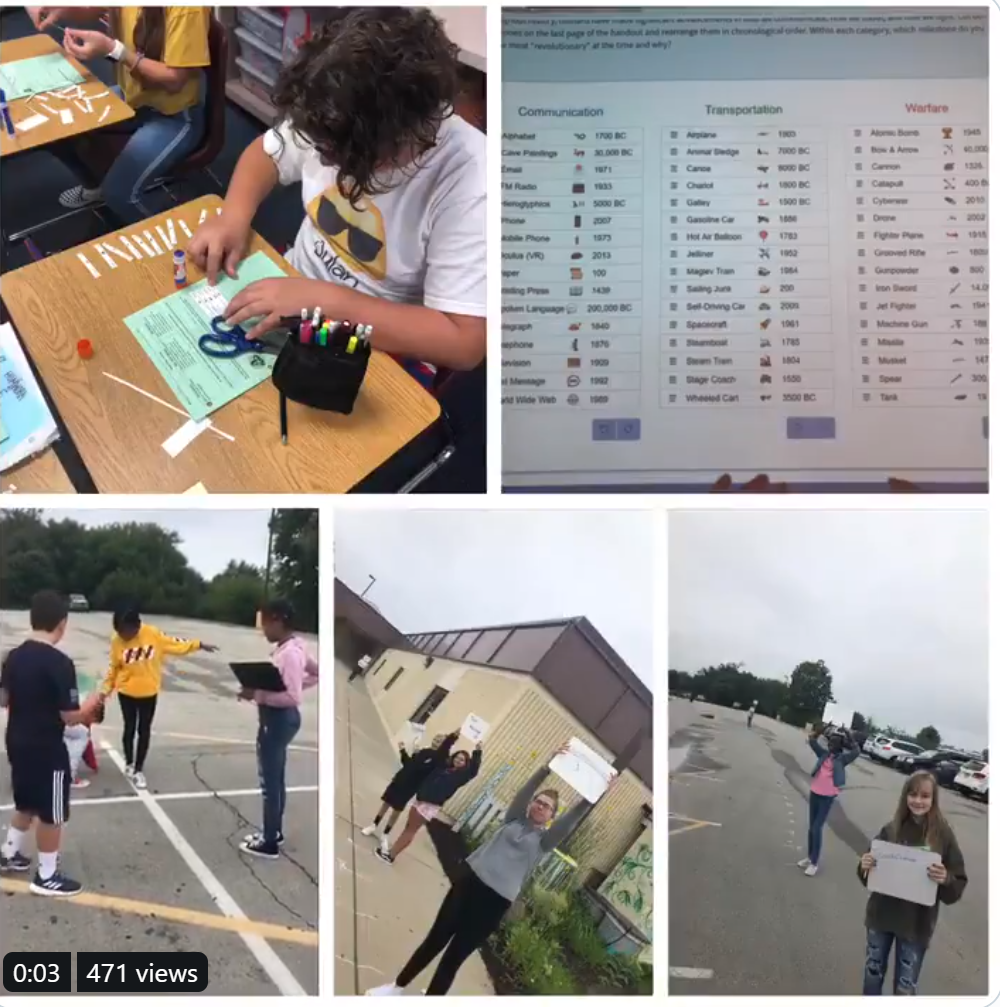
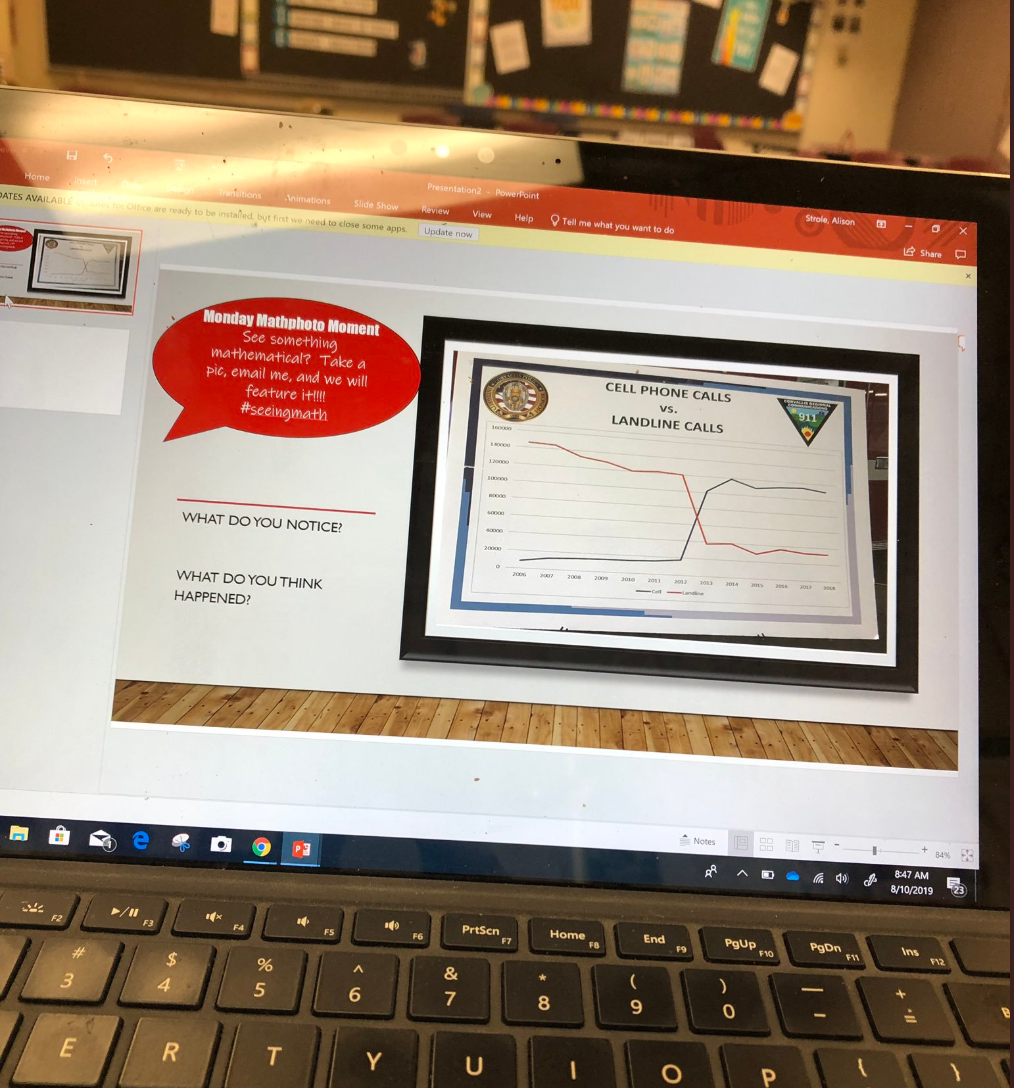
I wanted to find an activity that would tie into my first Monday Mathpic, get the kids outside, and help them to realize that integers play a role in their life, not just in math class. So I searched the various websites that are my go to places and found an activity called About Time. Our Monday Mathpic looked at the trends in 911 calls made with cell phones vs landlines from 2006 to 2018. This activity started with the kids watching the first iphone commercial. It then asked them to look at how humans have been making technological innovations throughout history – in communication, in travel, and in warfare. Over time, advancements from one milestone to the next have come more and more quickly. In the activity we modeled “before zero” years using negative integers. We then decided what an appropriate interval would be for our data set. Groups that didn’t choose wisely felt it in their legs by the end of the activity because they ended up doing quite a few squats. For example one group had to make a number line in the parking lot that spanned from 300,000BC to 2012. They decided that they wanted to go every 1,000 years as their interval. I asked them multiple times if that was an interval that they really wanted to use. They repeatedly said yes, so I told them to use it. About halfway through their number line the group called me over saying how sore their legs were. I said, I can only image… you are having to do lots of up downs to draw and write in the years. At that exact moment, I saw the light bulbs go off, “so that’s why you kept asking us about our interval selection? Next time we make a number line we are going to pay attention to the data more closely.” We then ordered and positioned the milestone innovations on our number line. Finally we found the difference between the integers and saw why we keep change change on subtraction. I was hoping that the students would see a connection, actually feeling a connection was an added bonus!
For years I would always give my students an end of course survey and ask them to strongly agree – agree – no opinion – disagree – or strongly disagree on a various list of questions about the class. Sample items were:
Mrs. Strole did a good job of making me feel comfortable with asking for help.
The notes in this class were useful.
The activities in this class helped me to better understand the material.
The review sessions before tests and quizzes were helpful.
If I am absent it was easy to find missing assignments.
After taking this class, Mrs. Strole has helped me to see the relevance of math in my own life.
I would always get agree or strongly agree for every question except for one. The students were not seeing the relevance of math in their own life. I was so disappointed because algebra and algebraic thinking are hidden all around. I had thought that I was doing a good job of highlighting that. So a couple of years ago I made it my mission to help my students to see math. I made a conscious effort to pick activities that matched up with their interests as well as had algebraic concepts that we were studying hidden in them. I always end up with lots of basketball players in my classes so I started our march madness bracket challenge and found a desmos activity that correlated a basketball shot to a quadratic function. During all of this I read Instant Relevance by Denis Sheeran and I was even more determined to make this happen. My results got a little better, but I was still under 50% of students who saw the relevance of math in their own life. Now if you know me I’m a very competitive person so this was not acceptable. I was just going to have to be more determined.
#seeingmath is born
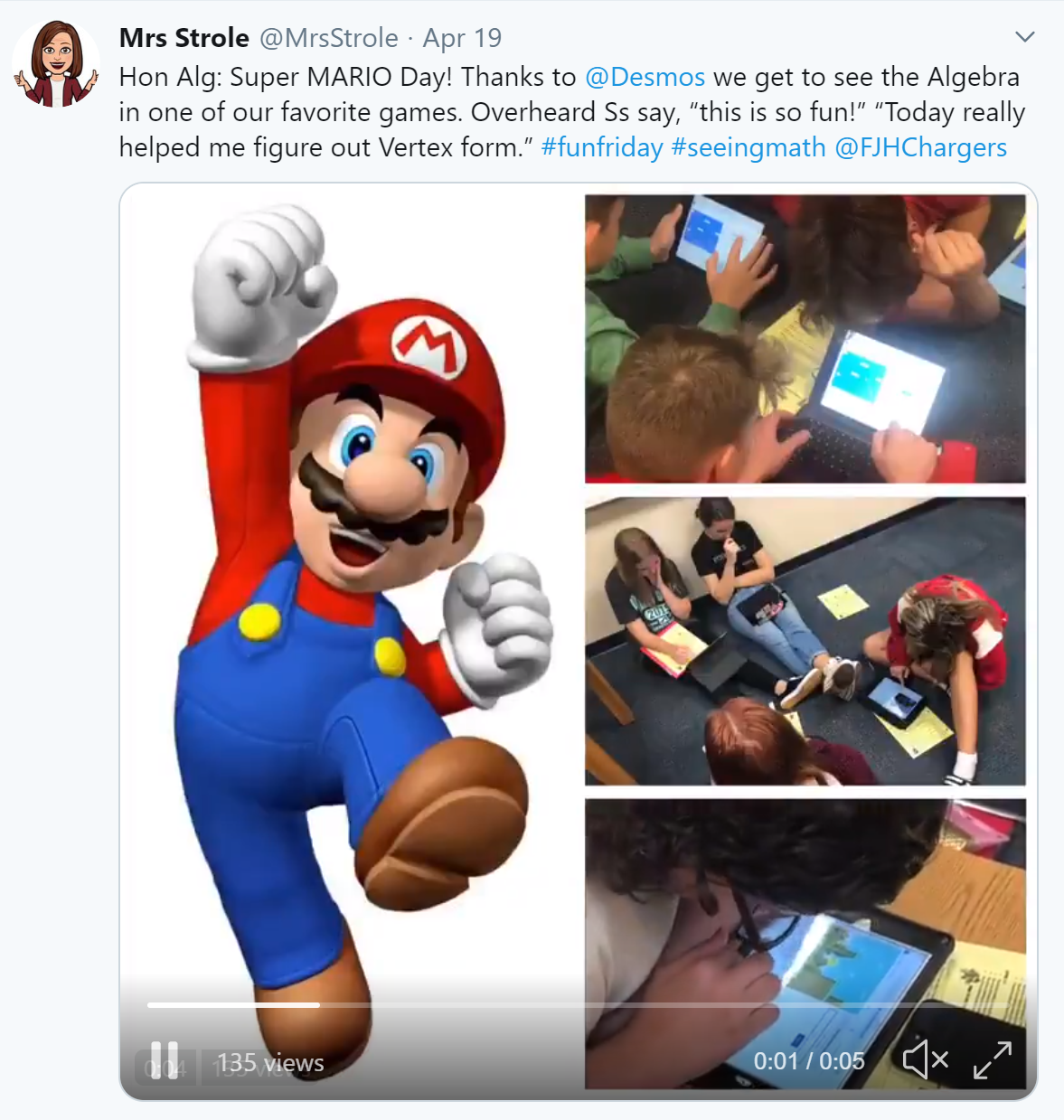
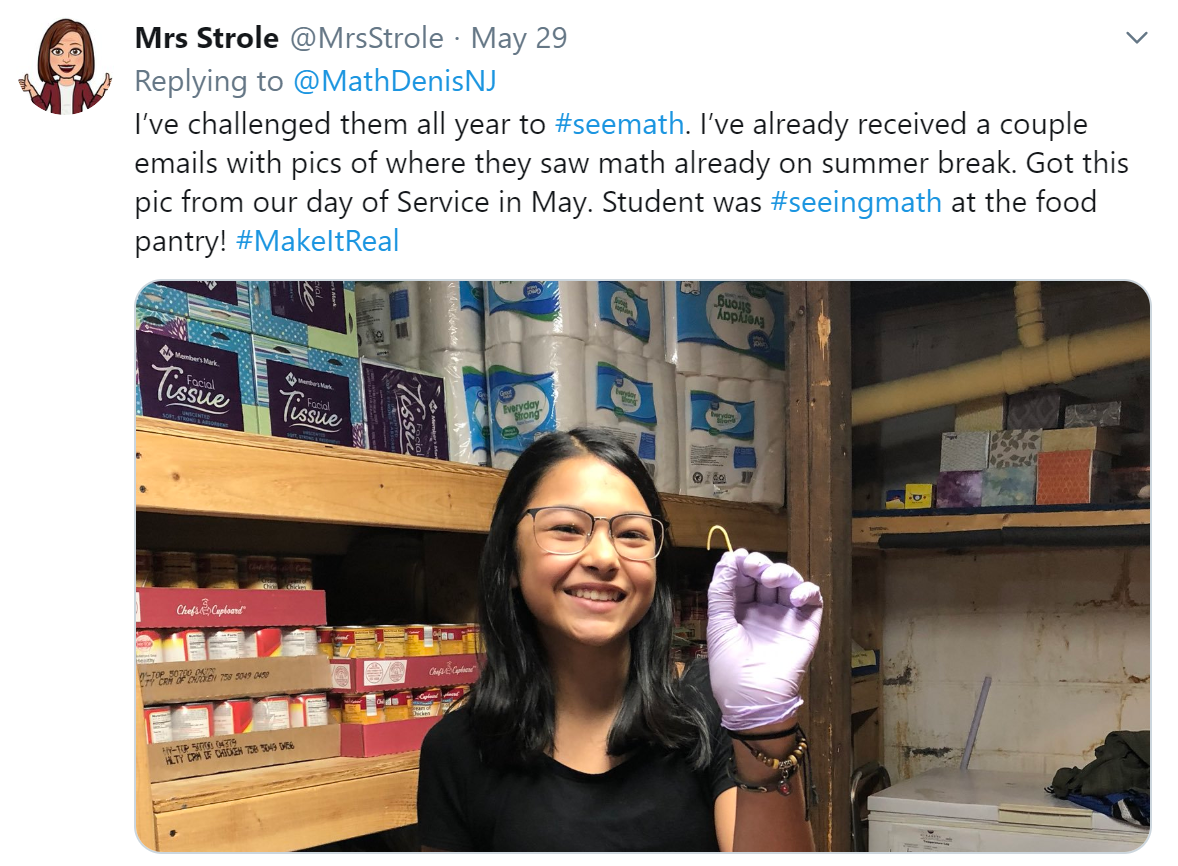
Last year, I started the #seeingmath hastag and tried to tweet out weekly activities that we were doing. The students started following. They would comment if I didn’t post any pics with them in it for a couple of weeks in a row. Students would say, “hey Mrs. Strole you should tweet this. This shows that exponential functions and tennis ball bounces relate.” Somehow, I had found a gold mind. I was running with it. Before Spring Break I challenged students to take selfies with any type of function that we had studied, when they saw it out in “real life.” I told them that we would highlight the quadratic functions that they found after break, since that was the unit that we were in. Over spring break, I tweeted every time we saw quadratics on our drive down to Florida. For their Seeing Algebra Showcase last year I opened up what the students could do for their showcase. I also explained that this year elementary students would be coming over to see what we were doing. A group of students said that they wanted to write children’s books using their selfie’s from spring break and then add to it. They said that way the elementary students would start to see that math is all over the place. My teacher heart exploded!!!!! The students did just that, they shared their books with the first, second, and fourth graders. One little first grader said during the Q&A with my student after they heard the book, “I’m never going to look at the McDonald’s sign the same. Now I know those are parabolas!” Their teacher emailed me later that day, to let me know that one of the boys in her first grade class said that if he had “infinite thumbs that’s how many he would use for today.”
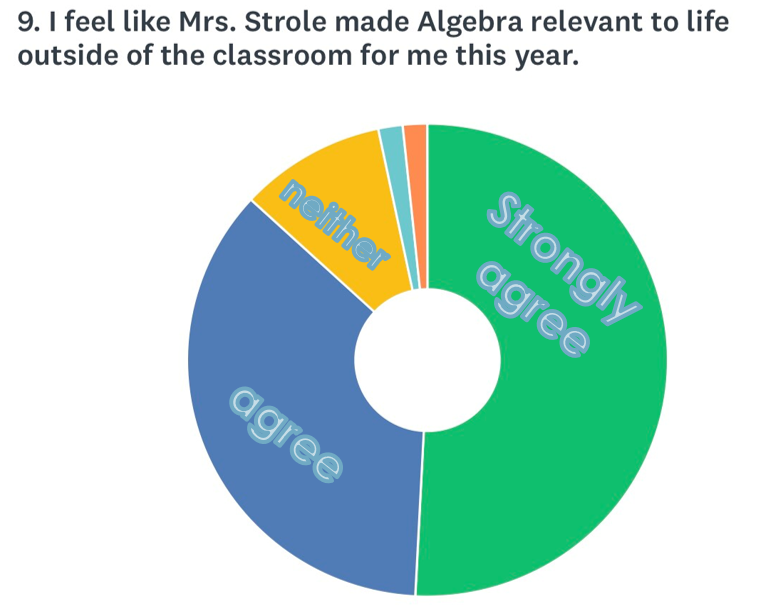
So at the end of the year, I gave the kids that same survey. I crossed my fingers that they had started to see the relevance of the math in their own lives. I waited for all the survey monkey results to come in and then I did a happy dance. 85% of the students said they agreed or strongly agreed.
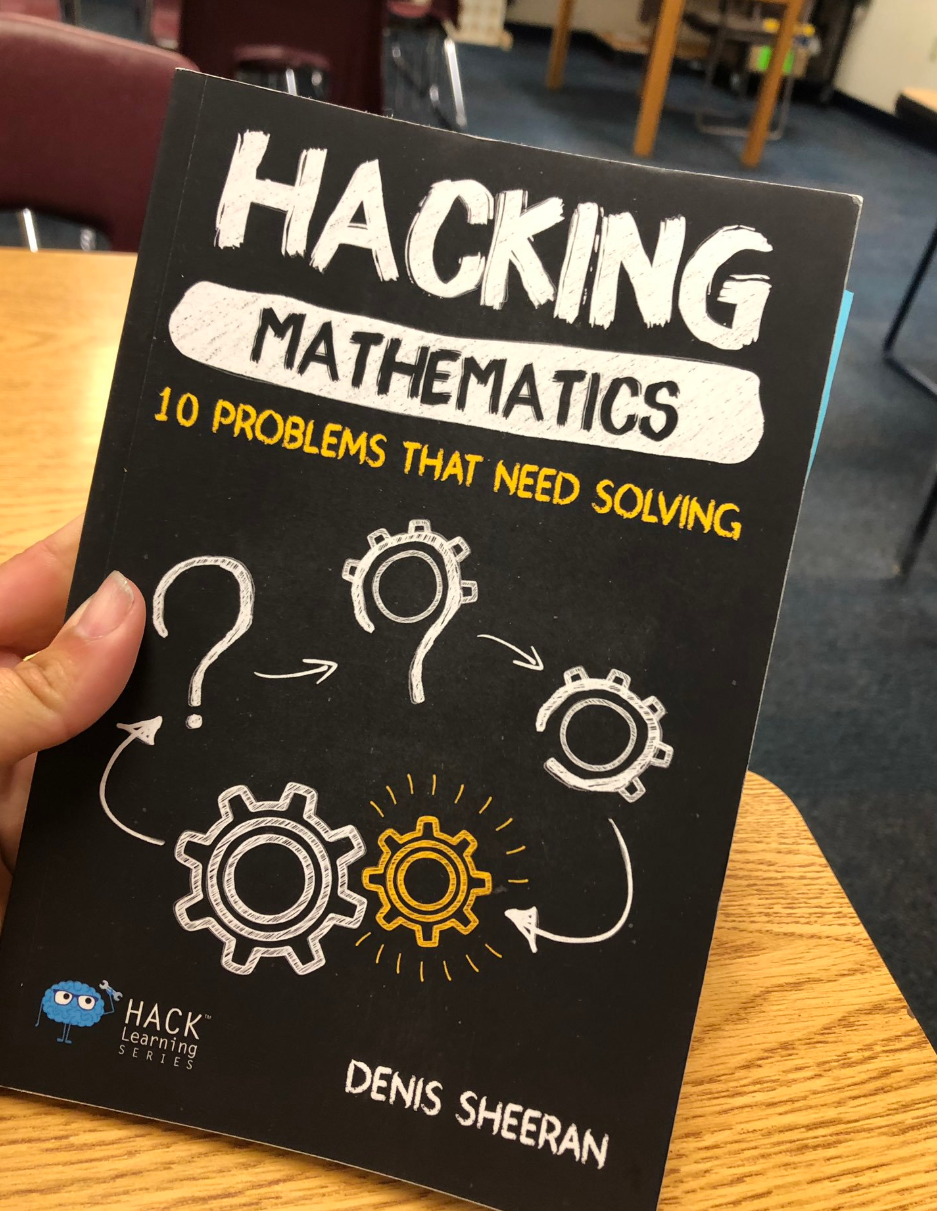
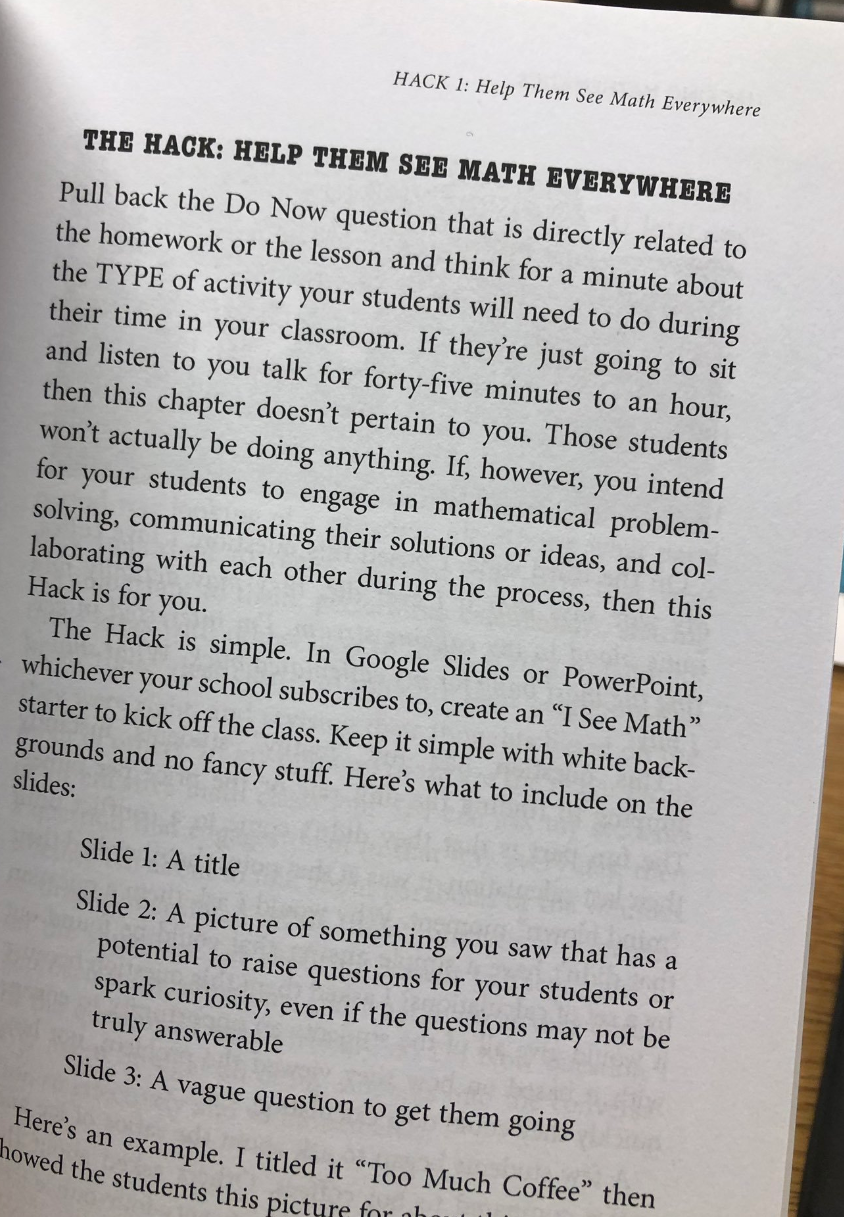
Now I’m determined to get 100% but I was ex tactic with those results. However, if you know me you know my competitive juices kicked back in and wanted to figure out how I could get to 100%. So over the summer I made it my mission to read and read and read and read. One of the books that had to be on that list was Denis Sheeran’s new release Hacking Mathematics. The first chapter had me hooked.
I also knew how much the #seeingmath tweets got the kids invested. Then I reflected on that fact that if the students hadn’t done the selfie challenge over spring break then that group would not have wanted to write the children’s books. So I came up with my take on Chapter One. I am going to do Monday Mathpic Moment. This week I am posting a graphic that was posted in a window. We are going to look and see what we notice and why we think it happened? Then I plan to collect data from all of my classes to see if our class data supports the graphic. Little do they know that on Wednesday we are going to look at the history timeline of technological innovations throughout history in communication with the telephone making many appearances as we review integer operations. My challenge will then be for the students to start taking a pic anytime they see something “mathematically interesting” out and about in their lives, email it to me, and hopefully it won’t just be me contributing to the Monday Mathpic Moment. I will update you later in the year to let you know if this was a two thumbs up or two thumbs down idea. I am hopeful it with be an “infinite” thumbs up idea and get the kids #seeingmath everywhere!
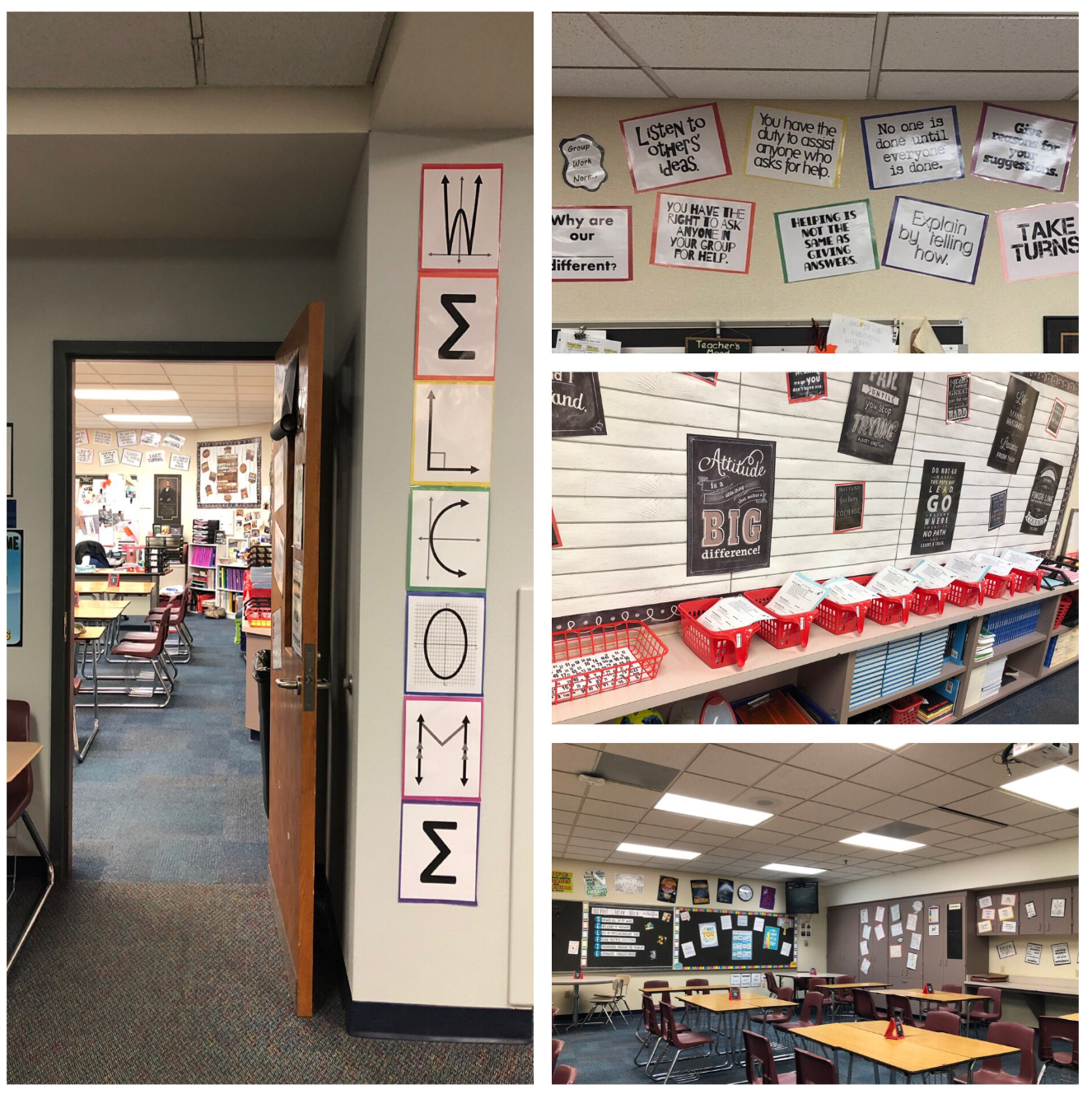
I started my 17th year of teaching. At the beginning of my teaching career I was so concerned with going over every rule, procedure, and expectation on day one to make sure the kids knew exactly what to do and how the class will run. However, as the years have passed I have realized that students rarely remember anything that you say on that first day, but they do remember how they felt. Did they think the teacher was nice? Did the room feel welcoming? Did they have fun? So over the last couple of years I have been very intentional with what activities I plan for the first couple of days. I have gotten much better at still laying the ground work for a successful year and what my expectations of them are, but in a more fun and engaging way. Every year, I go to bed the night before the first day with butterflies in my stomach as I nervously await to see if plans will fill the time and get the desired results. This year was no different.
I start off class with a round of Get To Know You Jenga. I challenge the class to see if they can make it through the entire class without knocking over the Jenga board. I love this because it incorporates problem solving as well as risk taking. The class comes together rooting on each person to successfully pull out the Jenga piece and lots of collaboration and communication as they give “suggestions” on which piece to pull for the best chance of success. Once they pull out the piece there is a question that they must answer before they can place their piece back on top. I learned this year that lots of my students want to move to warmer states like Florida or Hawaii. I have several students who enjoy biking (a great piece of knowledge that I can use later in the class to spark their love of math as we incorporate their love of biking). I have students who love Italian food as much as I do. However, my favorite response of the day came from a young lady who said that if she won a million dollar prize she would use it to help the homeless people in the state and then use whatever was left to help out her family members that are struggling. What a huge heart and another piece of information that can be tied into future math lessons.
From here I introduce myself as the number six. I tie in all the ways that the number six best represents my life. I then challenge the students to start brainstorming what number best represents them and how could they display that number in a visual way. On Friday we will pick back up on this assignment, when we head to the computer lab to start putting their ideas together for their My Life As A Number Project. In less than 10 minutes we have began to build a sense of community. They have learned more about their classmates and their teacher, and I have learned so much about their passions and interests which will help to guide their math journey this year and my ultimate goal of helping them to #seemath and see the relevance of math.
With the last twenty minutes of class we dive into our puzzle challenges. In math class this year we are going to do lots of group work. What better way to get them into the habit than by starting with group work on the first day. We set our group work norms and then the kids dive in. Most of these kids come in thinking that math is mainly computation. Now computation is a very important key to mathematics and poor computational skills will lead to other issues down the road, but my goal is for students to realize they aren’t just human calculators. Math is about risk taking. Math is about problem solving. Math is about collaboration. Math is about communication. Math is about perseverance and learning from failures. Math is about looking for and finding patterns. Each of the challenges the students will be participating in over the first two days of school force the students to work on each of these skills. Plus throw in some friendly competition (winning group earns the first Strole Bitmoji Badge of the year) and the kids are ready to go! Most groups only made it through 1 or 2 of the challenges today. Tomorrow they will get to come in and tackle the rest of the challenges for the entire period. Prizes are awarded at the end of each period on day2!
Challenge #One: 1 to 100 challenge. In this challenge students are given a paper with the numbers 1 to 100 mixed around the page. Each person in the group picks a different crayon from the box. The first person finds the number one and shades it in. The second person finds the number two and shades it in. The third person find the number three and shades it in. The fourth person finds the number four and shades it in. Then the first person finds the number five and shades it in. The second person finds the number six and shades it in. This continues until all 100 numbers have been shaded in. However, the fastest groups are the groups that find the pattern. After four or five rounds you could see the light bulbs go off, the groups huddled together, they whispered their observations to each other so no other group could steal their idea, they tested it, and once they realized it worked they were off and oh so proud to raise their hands when they finished and they beamed with pride as they completed their first “defend it” which is really just where they have to explain to me how they were able to beat the other groups using mathematical words and steps.
Challenge #Two: The Square Challenge. In this challenge students are given a baggie with five puzzle pieces and they are challenged to create a square. If they can make the square using four of the five pieces they will receive all 15 points. However, if they can make a square using all five of the five pieces they will receive 5 bonus points and thus making their chances of winning the entire challenge that much better. However, using all five pieces is much more challenging. I loved watching as the various groups tackled the problem. Some decided to start with the four out of five challenge and ensure that they received points. In this challenge, the group members really had to listen to each others ideas. There was LOTS OF FAILURE as they attempted multiple combinations until they finally found the correct grouping. Then other groups showed great risk taking as they went for the five out of five bonus challenge. This risk took lots of time, with no guarantee of any points. I loved learning which of my groups were the risk takers and which liked to play it safe.
Tomorrow groups will finish up the challenge as they tackle the multiplication with a twist activity which requires them to figure out what symbol pairs with what number. They are given 11 symbols and are told that they must match to the numbers 0 – 12. The symbols are used to make multiplication statements. This challenge will really ask them to use their computational skills, however, they will then have to look for patterns and problem solve. I love watching as the students use process of elimination (or really perseverance in failure) to start to piece the symbols with the numbers.
The final challenge is the match my image challenge. In this challenge the students are given a bag of dominos. Once student gets to walk up and take a “sneak peak” at the image I created with the dominos. The person who walks up and looks is the person who will then have to communicate to their group members how to recreate that image. They can not touch the dominos themselves. Each time that they come back up for a “sneak peak” they will lose one point from the total points possible. However, having me check the image and it being incorrect will result in a three point deduction. This challenge will force the group to pay attention to detail, be awesome communicators but even better listeners. This challenge is always one of my favorites to watch! There is always hair pulling, laughter, screams of frustration, and eventually dances of joy!
After doing variations of these challenges over the last couple of years. I will never go back to the old way. I have time to teach them about where to pick up papers and turn them in over the first two weeks. I can’t ever get back that first impression of my class. I can never get the “buy in” to the class that I get during the first week of school. I teach both the honors level algebra class as well as the remediation class. My Honors Algebra students are normally easy to please. They love the puzzles and challenges, but they also tend to love math already. This year will be all about pushing them further than they have ever gone and getting them to be mathematical thinkers and problem solvers, rather than regurgitation and computational experts. However my favorite comment of the day came from my remediation block class when a student came up at the end of the second period (I have this group for two periods back to back) and said, “I never thought I would enjoy having two periods of math. But today was actually fun Mrs. Strole. I’m ready to come back tomorrow!” Now that’s a win in my book!” By the end of the year, I’m determined to get the word “actually” out of the statement. That student will say math is fun!!!
Below are the 1 to 100 challenge paper as well as the template for the square challenge puzzle.



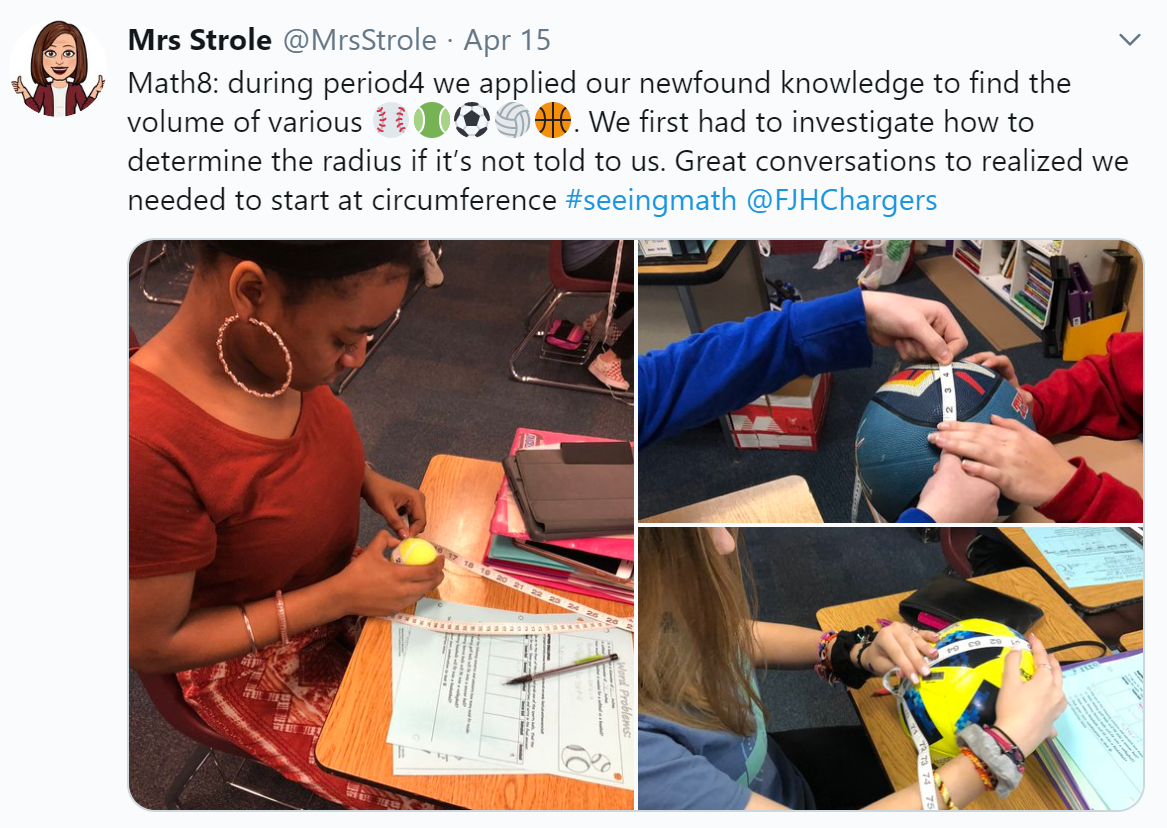

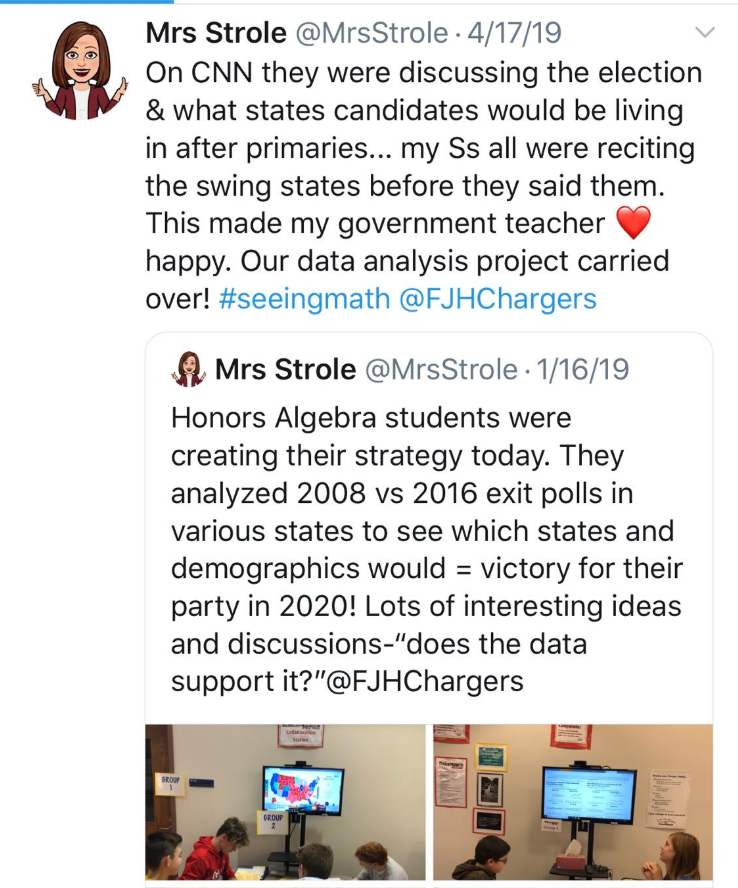
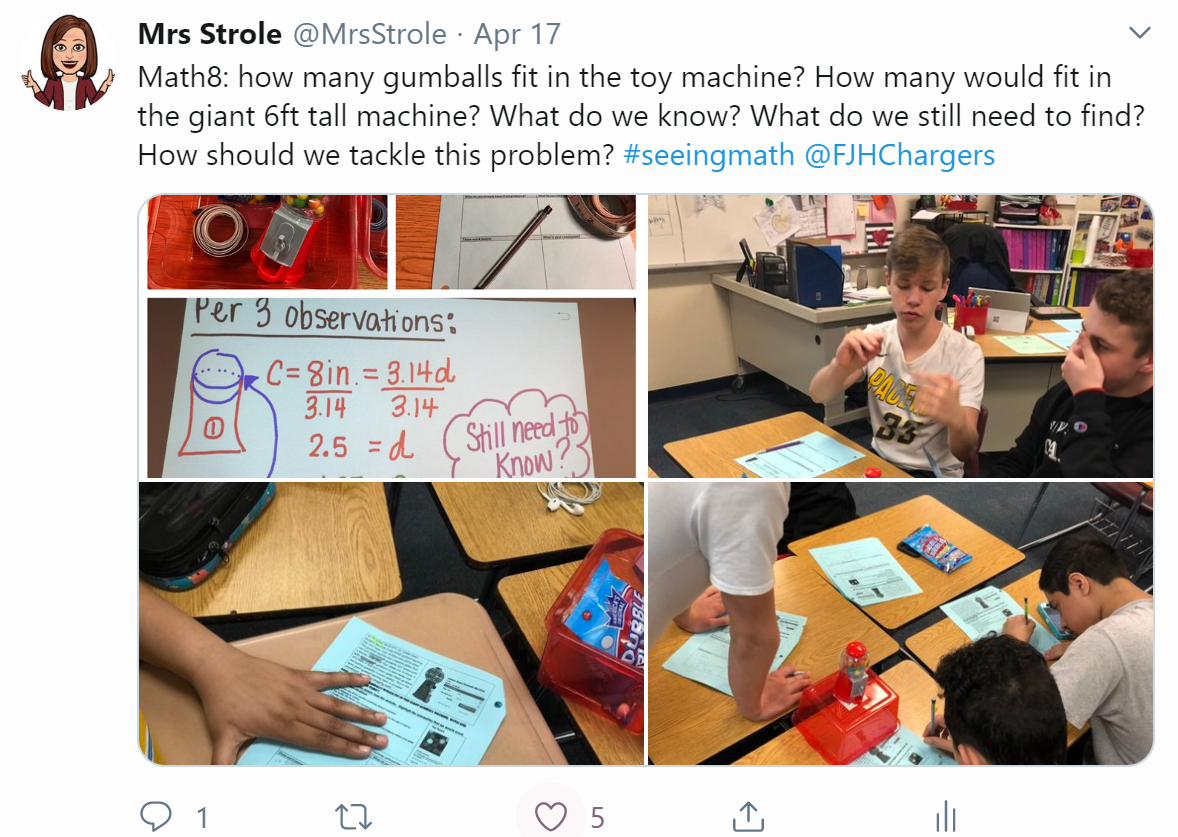





 #seeingmath with Mrs Strole